Thanks for the pointer, BoingBoing.
Tuesday, January 29, 2008
If Apple Sold Sheets of Paper...
Thanks for the pointer, BoingBoing.
Monday, January 28, 2008
The Realm of Sociality: Notes on the Design of Social Software
I'm not a social software designer. But this paper is really insightful! It titled: "The Realm of Sociality: Notes on the Design of Social Software" by Wim Bouman, Tim Hoogenboom, Rene Jansen, Mark Schoondorp, Bolke de Bruin & Ard Huizing. It won the ICIS 2007 best paper award.In short, it's a model to support social software design. The design of social software "is a multidimensional problem that streches beyond connecting people and information." They "hypothesis that, in order to create social software, a designer has to address in one way or the other all issues of enabling practice, mimicking reality, building identity and actualzing self." Using a "soft systems methodology approach" the ended up with "A Conceptual Model for Social Software" (refer to Figure). This then resulted in "A Design Framework for Social Software". Again, I'm not a social software designer. But what struck me when I read this paper is that this can also be used to judge social software and analyze if the new application is any good. I'm not saying that all domains must be incorporated in social software (- which is possible future research, according to the conclusions of this paper). But the domains can be used to structurally evaluate the components of a new social software tool.
The Life Cycle of a Blog Post
Friday, January 25, 2008
A Paperless Office?
Two nice posts here and here on why these two people think we won't have a paperless office any time soon. Although they do point to ways to make your office more paperless.I agree with both that we won’t have a paperless office any time soon. The book "The Myth of the Paperless Office" clearly describes the affordances of paper and that of digital 'paper'. Furthermore it shows why some affordances of paper will not be possible for digital documents any time soon. Try to make a pile of digital documents, for instance. However there are some interesting trends, like multi-touch interfaces, that give some hope for a paperless or less-paper office. As for now, I’m happy with both.
Good Questions about Intranet
A Semantic Web killer app
What my killer app would be? It would be something like this. A tool that helps me when I write emails and documents. It reminds me of related (truly related, not just based on key word comparison) emails, documents (I wrote before), Internet pages (I visited before), etc. in a non-intrusive way.
But for now, the "Shortcuts" are indeed, a good step in the right direction. What "Shortcuts" are? Go ahead and read Iskold's post!
Thursday, January 24, 2008
20 Questions about Blog Reading
Everybody's a Knowledge Worker?
I don't want to get into this deeply, but love to point you to this insightful discussion. Acidlabs bundled the relevant posts for us.
Wednesday, January 23, 2008
Paper and Digital Information Capturing...
Tuesday, January 22, 2008
On Corporate Intranet
First of all I'd finally - I know I'm way too late... - like to point you to the extensive and insightful "2007 Global Intranet Survey Report" and "Trend Report" by Jane McConnell. There's too much stuff to chew on in there for me to summarize it for you. You can find the author's summary here and order it there.
So, what's up for the future of Intranet? Here are some predictions.
And Jeremiah Owyang has an insightful post on "challenges, evolution and success factors for the Enterprise Intranet". Intranet is "a direct reflection of your corporate culture", he states. And:
If a company’s competitive strength is it’s employees and how they work together, the intranet is a valuable tool. Secondly, with many baby boomers in the United States retiring in the near future a great deal of corporate knowledge will be lost, how will you capture and distribute this tacit knowledge?This applies to Europe to. Jeremiah continues to describe the evolution of Intranet in companies. This relates well to Jane McConnell's "paths" of Intranet development.
Another interesting tip he has is to check the Corporate Intranet first before you accept a job at a new company. Why? Go and read the post, it's worth your time!
So, what is an Intranet anyway? Richard Dennissen from BT has an interesting definition. (Found this at ColumnTwo, by the way. Thanks!)
More stuff from BT: "6 lessons for building a successful Intranet". I like how they relate 'social media' to their business goals and not adopt it for it's own sake (sheet 5). I also like (sheet 26) the easy "type of page" selector! And again, sheet 29, the adagium is to "start small".
So, what's the plan for 2008? Jane has a good list. Practical and straight forward!
Using Xobni
Just started using Xobni! Some time ago I pointed to it, but now I'm experiencing. And I very happy up until now. It looks nice, works quickly, is insightful and gives me good overview. I agree with Frank Goertzen (comment on the ReadWriteWeb post on Xobni that "it adds value to something I'm already using." It gives context to all the stuff that's in my email: emails, files, contacts, meetings, tasks, etc.So, what's Xobni? There are some good reviews here by ReadWriteWeb, Web Worker Daily and TechCrunch (there's a summarizing video there too).
Some problems I am experiencing are: Outlook seems to slow down somewhat and it seems to dig up old tasks that I finished a long time ago and present them as To Do's. And my SyncMyCal has disappeared...
I was wondering if Xobni also searches my archived items. That would be nice and it would also explain why it shows my old To Do's.
Monday, January 21, 2008
Google docs and the future of document management
However, there is another issue to be addressed: if all employees will be able to use their own email and collaboration apps, how do you facilitate knowledge sharing and reuse in the organization? Any ideas? Should the Information Management department monitor all these email and collaboration apps and manage the interesting stuff centrally?
Saturday, January 19, 2008
1st Blogging Anniversary!
Wow, today's my first blogging Anniversary! I actually started out just wanting to try blogging and see if it work for me. Is blogging useful? Does it get me anything? Will I be able to write posts in my spare minutes/hours? Will I only be writing for myself or will others also like what I write?Well, in short: blogging is cool and exciting. I started out writing a blog post once every week, but got up to speed, writing a post practically every (work) day. That ended up in writing about 180+ posts in the previous year. Blogging really helps me structure my thoughts on all the stuff I run into (on the Web). It helps me bundle links and thoughts on a certain topic.
Several times I also used posts to pass on my thoughts to other people, that didn't read my blog regularly. I think my blog is pretty focused. I don't write on personal stuff or politics, for instance. I don't intend to either. I plan to keep on posting on work-related topics.
I'm really thrilled that about 40 people subscribed to my blog. I know about 5 of them personally, the rest are unknown to me (- sure would like to know who they are). I started out blogging just for myself. And thought: if anyone wants to read what I think, Go ahead! But, to be honest, I was very excited about the first comments on some of my blog posts. It's a wonderful experience to know that people are reading your posts and thinking about them, and even take the time to write back.
I have two 'live blogging' experiences. This is really good for your subscriptions. I had about 60 subscribers while live blogging. In de previous year I also started an internal blog (actually the first...). Another colleague also just started. Hopefully this will pick up some speed soon.
As for this blog: I'm definitely going to continue blogging!
Thursday, January 17, 2008
Dissertation on Mass Collaboration
Haven't read it yet, but did print it to read it soon.
Wednesday, January 16, 2008
CoCreate integrates CAD and Sharepoint
I was wondering: Is it also possible to view the actual CAD model/file in Sharepoint (not encapsulated in Word)?
Tuesday, January 15, 2008
Video Presentation by David Allen on GTD
5 dangerous things you should let your kids do: Gever Tulley on TED.com
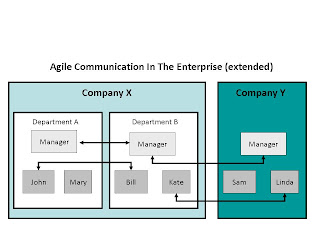
Comments on "The Social Enterprise - What Works, and What Doesn't"
This post gives a good overview of why and how companies should use social media (internally and externally). I agree with most of the post.
I do have a couple of comments and questions:
1. Alex ask “Do corporations need social networks?”
I would say ‘yes’ because companies are inherently social, or at least, they were when they started. Companies are built up by individuals that got together because they have/had a shared concern. If these individuals are not social, there would be no enterprise.
Or do you mean ‘social network applications’?
2. I missed one (to me) important dimension in Alex’s “Agile Communication in The Enterprise”. It focuses on one company with two department. But isn’t the real issue for companies a little bit more complex? And isn’t this a very important reason to devise new work methods and tools to support this change? I extended Alex's figure to explain what I mean. Most companies now are busy working with partners, outsourcing and insourcing stuff. This has major implications for organizational structures, work methods and system architecture and information security. Companies are now more and more multi-site, collaboration with a part of the company somewhere in the
3. I missed a very basic, but essential tool for the social enterprise: document management. It fits in the category “Web Office”, but I’m also talking about versioning, checkin/out, etc. Derek (comment nr. 4) also mentions this in his comment and points to Sharepoint, etc.
Alex also asked “what social tools we are discussing or using today?” Basically were investigating all the tools you mentioned. None are being used internall at the moment, except for wiki’s. We are using wiki’s a lot for about 2 years now. They’re mostly used for document collaboration and, specifically, to keep work method manuals up to date. But project management is also being done using wiki’s.
IT resources focused on (un)structured data
predicts this:
By 2011, IT will allocate 75% of information management (IM) resources (people, systems and software) to integrate and analyze a blend of traditionally structured and diverse data types, whereas today 75% resources are focused only on structured data.Source: Predicts 2008: Information Infrastructure Will Help Master Chaos (Gartner Research, G00153199, Dec. 5, 2007)
Managing for Breakthrough in Productivity
Friday, January 11, 2008
An architecture to Manage Structured and Unstructured Information
Relating to this post by Column Two, which is more about web content structuring/un-structuring, I'd like to ask you the following questions. But first I'll give you some context.
Introduction
Product research, development, engineering and manufacturing is an interesting process. To certain extent it is structured and follows agreed upon work flows. On the other hand much is done in an ad hoc and unstructured way.
An important part of product research, development, engineering and manufacturing is information management. To design a product information must be gathered, structured, distributed, searched, etc. Over time a clear description of this product (part) is stored, versioned, communicated, etc. These facets of data, document, information and knowledge management are also sometimes very structured, while in other parts of the process totally unstructured.
Most companies manage structured data, documents and information fairly well (in PLM and ERP systems). Most information architecture/management models therefore focus on this type of data, documents and information. These models are typically “top down” (master data, fixed product structures, etc.).
However, a large part (approx. 80% they say) of the information in an organization is unstructured. This type of information is usually not managed, because it “has to be structured to manage it”. If it is “structured” this is done “bottom up” (tags, folksonomies, light-weight document management, etc.).
Due to the Internet more and more attention is being paid to managing unstructured information. Some even state that information is never “structured”. Structuring information disembodies it.
The structured and unstructured information world seem to be distinct. Models for managing both types of information in a coherent and consistent way do not exist.
Questions
Most information architecture models do not incorporate both types of information a company is managing or should manage. It is assumed that most architecture models work best for structured (logical) business and information processes.
Therefore my questions are:
- Are there information architecture models that comprises structured and unstructured information management?
- Is the term ‘structured’ and ‘unstructured’ concise to distinguish these types of information?
- If your answer to question 1 is 'yes', do you have experience with that model?
- Does that model have added-value above the other information architecture models.