Posts

The Future of Enterprise Content Management

Image
John Newton (co-founder of Documentum and Alfresco ) has an interesting post on 'The future of Enterprise Content Management' . This guy knows a lot about ECM and I find him a thought-leader in this area. Here's some of what he had to say in his long, but very interesting post: My guess as to what will happen to the ECM market is: SAP will buy an ECM vendor further filling out one of the prime stacks in Geoff’s Stack Wars OpenText continues to look for a buyer. Could they hook up with SAP after being jilted by Oracle? OpenText ’s iXOS acquisition makes this an attractive pairing. Vignette, partnering with companies like Microsoft, are testing the waters for a possible acquisition Interwoven is testing a niche play by retreating into Marketing applications, but may still opt for being acquired. EMC could do worse than to acquire Interwoven. They could also help Microsoft. The remaining players (other than Alfresco) will retreat into niche areas either around vertica...
Wikinomics

Image
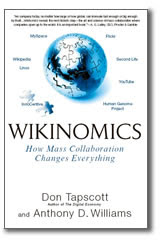
Just recently HBR IdeaCast had a cool interview with Don Tapscott . He's one of the authors of Wikinomics . How mass collaboration changes everything . I just ordered the book. Tapscott has some interesting remarks. I'll give you a few snippets: "You have four big factors coming together at this unique time in economics and in human history: 1. the new web, ... the old web was a publishing platform ... The new web is based on XML and it's creating a giant global computer that everyone programs whenever they use it. So this is creating a platform for self-organisation. 2. Second factor, there's a demographic revolution. The children of the baby boom are the first generation grown up bathed in bits. These kids are different, they process information differently, they think and behave differently. And they are now the biggest generation in the workforce and in the marketplace, they're coming into the workforce and the marketplace. Put those two together and you...

Adopting wiki's - wikipatterns

How do you use wiki's in organisations? How do they fit in your information architecture? Aren't wiki's too loose? In what situation should I use a wiki? What is a good configuration for my project wiki? An interesting new initiative has been launched to help companies answer these questions. It's called wikipatterns . Go ahead and take a look. Two good posts about wikipatterns can be found here and here . Larry Cannell of Collaboration Loop (first 'good post') asked the following interesting questions after looking at wikipatterns : Does WikiPatterns represent a key piece to enabling companies trying to fill the gap between IT and Business and help drive adoption of new technology? Can patterns be applied to other technologies like Microsoft SharePoint or eRoom ? Are product-specific patterns sustainable or do patterns only apply to a capability (like wikis )? Are there, or should there be, patterns for blogs, social networks, or other Web 2.0 technolo...

Information Overload

On the eMarketer site I found this interesting article about generating, digesting, judging and coping with information. Lots has been written about this topic, under the title 'Information overload' (or 'cognitive overload'). They also give some interesting statistics. I want to comment on some parts of the article. It states: "Like it or not, marketers today are on a constantly accelerating treadmill where they need to get data faster, make decisions faster, execute faster, measure faster and even make mistakes faster. Particularly in digital marketing, the game is not won by endlessly debating what might work, but rather constantly iterating within the marketplace," said Mr. Ramsey. It is more important than ever to get the right data, quickly. Yet it is more challenging as well. The information-gathering process at most businesses is neither efficient nor effective, according to a survey of more than 1,000 middle managers in the US and the UK conducted by...

wefeelfine.org -- Addictive Visualization of Collective Sentiment

Image
The O'Reilly Radar pointed to an interesting new site called wefeelfine . What's it about? "Basically, blog data is collected and searched for variants of the phrases 'I feel...' or 'I am feeling...' One of 5,000 predefined feelings is associated with the post and the other database attributes are loaded. The 'mobs' has options to display 'most common' and 'most salient' characteristics of the data. The animation is done in processing." (...) The interface to this data is a self-organizing particle system, where each particle represents a single feeling posted by a single individual. The particles' properties - color, size, shape, opacity - indicate the nature of the feeling inside, and any particle can be clicked to reveal the full sentence or photograph it contains. The particles careen wildly around the screen until asked to self-organize along any number of axes, expressing various pictures of human emotion. We Feel Fi...

Google Steps Into Microsoft's Office

Not to long ago I wrote about Google's information architecture . I didn't get any answers to my question what Google's info architecture looks like (yet). But I did get answers to this question I asked: Although Google products are free and can also be used in enterprises, I haven't heard of many companies dumping Microsoft and using free web 2.0 stuff (from Google a.o.) from then on. But then I ran into this article a couple of days ago: "Google steps into Microsoft's Office". One of the companies that's thinking about swapping their old email system for Google (Apps for your domain) is Pixar Animation Studio's. Greg Brandeau is itching to dump the decade-old, homegrown e-mail system he manages at Pixar Animation Studios Inc.. And the senior vice-president for technology at the Walt Disney Co. unit is sure about one thing: The replacement won't be Microsoft Corp.'s Exchange and Outlook duo, whose e-mail, calendar, and other programs do...

Lego Mindstorms

Image
Just got my Lego Mindstorms from the States. Of course I bought this for my son Nathan - as you can see. I really look forward to see him build robots and play with them. What this has to do with 'information architecture'? Absolutely nothing. Just wanted to let you know I'm looking for ways to explain why a grown-up would buy Lego... ;-) Samuel