Posts

Building Your Social Intranet

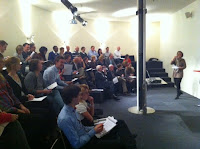
How do you build a social intranet in your organization? I get this question a lot. At the Intranet Conference 2012 in Utrecht I gave a talk about 'building your social intranet'. I've shared my slides below with my answer to this question. I define six steps towards a social intranet. In a couple of posts I'll share my story and experiences on this topic. As always, I'd love to hear your thoughts on this topic. Building your social intranet View more PowerPoint from Samuel Driessen Let me start by defining what I mean by a 'social intranet'. Based on responses from the audience, the definition of social intranet is not very specific. Some say it's internal social media. Others said it's internal Facebook. A simple definition of a social intranet is an intranet that has been extended (and integrated) with social tools. This definition is OK, but it's pretty tool-focused. To me a social intranet is an intranet that is focused on and ...

Relating your purpose to your current tasks

Image
Oof, it's been a while since I blogged... Hope you missed me! ;-) A post by John Stepper triggered me to rejoin the blogosphere. Of course I've been paying attention to the blogposts, reading and commenting on them. But I simply didn't make the time to write a blogpost of my own. John wrote an interesting blogpost about an internal course he's giving. And the topic of the first course is defining your purpose . That's a very big topic. And it's hard for people to define what their purpose is. John bumped into this issue when running his course. I recognize this big time! This is what I was struggling with when I started working. I read lots of productivity books and they all said: "Define your goals and purpose. Do what you're passionate about." So, you start to wonder what it is. You see all these smart and successful people around you that seem to have a clear purpose. They can articulate it as if they always knew what there purpose is. I...

User adoption strategies for Sharepoint - part 2 #intra12

Image
Part 2 of my notes from the workshop about User Adoption strategies for Sharepoint by Michael Sampson . (Part 1 can be found here .) We're at stage 3: Enlivening Applicability. Ways to do this: Over the shoulder watching: show how people use the tool in practice and learn from them Group re-imagining: help a group see beyond current work practices Embedded champions: one participant mentioned she connected to secretaries to speed up and encourage technology adoption. ( I agree! ) Sandbox for experimentation: don't go live right away, but start small, let people play with the technology and use the technology for the roll out itself. Easy first steps: closing down the options, focus on some affordances of the technology not all. Built it and they will come: set up the tech and see if users will adopt it by themselves Next phase (4): Making it real. How do you make it real? Provide zero other options. E.g. take away all other platforms but one. Experience from th...

User adoption strategies for Sharepoint - part 1 #intra12

Image
My notes from the pre- conference workshop with Michael Sampson about User Adoption strategies for Sharepoint. (This workshop is part of the Intranet Conference .) Technology is easy compared to getting people to use the technology. Most people aren't first wave users. They don't say: Give the new tech to me. They ask: "Why should I use it? What is the reason for the new technology? My work has to be improved by the new technology." They basically tolerate the tools. If something is easier it's better for them than that it is perfect. Most organizations assume adoption will be 100%. So, there's a problem. The objective is not user adoption. It's the overal effectiveness of the organization for instance. Or, improve work. The overal approach to user adoption is very important. (Refer to the Collaboration Roadmap .) Research shows that people are least satisfied when IT rolls out and the most dissatisfied.... Sharepoint is a platform. This means ...

A week in the digital workplace by @s2d_jamesr

Image
What’s it like in the digital workplace? James Robertson recently published a report to answer this question . He took a storytelling approach and gave us insight in what working in a digital workplace looks like. In this way he hopes to make the digital workplace more concrete. This is necessary because James there's lots theoretical and abstract talk about it. James’ report wants to bring the digital workplace closer to us. I enjoyed reading the report. In several steps James takes us through the digital workplace. He shows how a new employee would use the workplace during the week using all kinds of concrete examples. Like a personal welcome message, a pre-populated tasklist, information about working methods, mobile intranet, accessing operational information about e.g. hotel bookings, an overview of company numbers and real-time performance data. James rounds up his report by listing 6 keys to the digital workplace (Identity, Awareness, Trust, etc) and also poi...

My latest Frankwatching posts

Just a short post to point to my lastest posts for Frankwatching . All posts are in Dutch and some have been posted here on infoarch as well. Waarom is intranet zo simpel? Social Business, stapje voor stapje vooruit Van intranet naar digital workplace: trends 2012 De blogosphere van 2011

Reflections on the Enterprise 2.0 Summit 2012 #e20s

Image
Another reflective post ... Hey, it's Friday! :-) This post is long overdue, but I promised I would reflect a bit on the Enterprise 2.0 Summit . I'll keep it short. I enjoyed the Summit and hope to be there next year as well. What did I enjoy most this year and hope to see more of next year? Here's my list: Some of the speakers shared the failures and dark side of enterprise 2.0. I think we need to more of these kind of examples. Not to focus on the negative side of internal social media, but to learn from failure and the unexpected. I agree with Ana Silva  we need more, deeper and detailled stories about e2.0 deployments. How did they really  do it? And then we can discuss the cases, share experiences, etc. This implies we need good stories and storytellers, and excellent workshop/discussion moderators.  I hope we'll hear more about mobile and location-based systems. Most of the cases were about social networking and microblogging platforms inside the org...