Posts

Showing posts with the label process

Choosing the right social tool - Reflecting on the #SocialNow conference

Image
Many companies are looking into social tools for their internal organization. Lots of others just select what related companies have chosen. Hoping this is the right choice. As with selecting content management systems, many struggle to select a social platform. There are so many tools out there and they all say they can help you support internal networks. How to choose the right one? Is there a right one? Does the success of a tool elsewhere mean it will also be successful in the company you work for? The Social Now conference in Porto (June 26-27), organized by Knowman , addressed these questions. And it did so in a unique way. Basically the idea was to have social tool vendors present based on a concrete company case that wanted to move forward in knowledge sharing, idea management and collaborative project work. The vendors were asked to share their approach in 20 minutes and then an expert panel helped the company ask the right questions to the vendors. Many brave vendo...

Social Business Excellence by Yves Caseau #e20s

Image
Yves Caseau of Bouyeau Telecom is the second keynote at the Enterprise 2.0 Summit. His talk is about Social Business Excellence. Caseau starts out by giving an overview of the changing landscape and the need for social business. But also shows that elements of Enterprise 2.0 are very old (e.g. lean and 2.0 are closer than you think). His slides give a nice overview of the elements of social business found in lots of older management books. It shows that social business is an integration of many (older) insights. There is a need for more business agility, because environments are changing faster and are more complex. Enterprise 2.0 is a cure for "common congestion". Enterprise 2.0 solves 1.0 problems. For instance, how do we reach the right people. E2.0 tools help to do this faster and easier. And, another example, slow convergence of multi-author editing. Recommendations: Integrate 2.0 in (decision and business) processes, not next to it Laissez-faire & faire...

Expectations for the Enterprise 2.0 Summit #e20s

Image
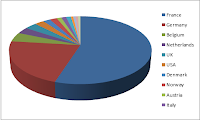
I'm really looking forward to the Enterprise 2.0 Summit ! Are you coming? If so, I hope to meet you there! Recently the organizers shared a pie chart of the participants per country. To my surprise hardly any people from The Netherlands are coming! I was wondering why hardly any Dutch people attend this conference. Last year I was there with one other Dutch guy. I know of many people in Holland who are interested in Enterprise 2.0 and social business. So that can't be a reason. Is the conference not well-known? I don't think that's the reason either. The location can't be a problem either. So, what is? Let me if you have any thoughts on this. My goal is to get more people in Holland interested in the summit and hopefully many more fellow Dutchies will be at next year's Summit. And for this reason I won't just be blogging in English but also in Dutch about my conference learnings. What are my expectations for this year's Summit? Last year we had...

Social Business Doesn't Mean What You Think It Does, Neither Does Enterprise 2.0

Image
Some time ago Deb Lavoy wrote an interesting post titled 'Social Business doesn't mean what you think it does, neither does Enterprise 2.0' . I just wanted to point you to it. The discussion around the post is interesting.  I also commented on the post. I'll mix it into this post and hopefully you'll read Deb's post and join the conversation. I like the way Deb links social business to deeper societal and even philosophical movements. I think this is one of the reasons Tapscott c.s. wrote the book 'Macrowikinomics' . W.r.t. philosophy she relates social business to Enlightenment 2.0. I was wondering if we can just say it relates to the current philosophy, postmodernism (- there is no absolute truth, everything is fragmented, deconstructionilism, subjectivism instead of objectivism, etc)? Extending that thought, we know philosophies come and go (objectivism is followed by an era of subjectivism, then objectivism, etc). I think we are now learning t...

[Request for Input] Control and audit implications for social media

Image
In a couple of weeks I'll be giving a masterclass with prof. Eddy Vaassen about 'Control and audit implications for social media' . Wow, what a title, eh?! This masterclass is part of a large conference in Holland organized by NBA-VRC for accountants and controllers. The topic of this year's conference is Customer 3.0 . I'm working on the slides for the masterclass. And I'm curious what your expectations are when you read the title of the masterclass. What topics should be addressed? What are control and audit implications, according to you? Do control, audit and social media relate? If so, please explain. Of course we'll share our slides as soon as they're ready. Feedback on those slides is welcome, as always.

Why is Intranet so Easy?

Image
Recently I blogged about why intranet is so hard . This struck a cord, it seems, because it received several good comments! At the end of that post I promised to write about the easiness of intranets as well. My post about intranets being hard didn't want to imply it's impossible or frustrating to develop, implement and maintain an intranet. The fact that it's hard intrigues me and keeps me interested in intranet. However, intranet can also be easy I think. I'll explain why here. I'm really curious if you agree/disagree. Intranet deployment is usually a complex exercise. Lots and lots of requirements from different people and roles are collected. And these are squeezed into one overall intranet concept. Then building and deployment begins. But what is an intranet? It's a collection of webpages, containing content, linked together. Sometimes added with a couple of web applications, like a people finder. Yes, the Digital Workplace. So, why don't we j...

More Structure in Knowledge Work

Image
A while back Thomas Davenport wrote an interesting McKinsey report 'Rethinking knowledge work: A strategic approach' . It's a thought-provoking piece. It goes against the trend to say knowledge workers should be left alone, they're smart and know what to do. Davenport says we should provide more structure to knowledge work. Providing knowledge workers "well-defined context of tasks and deliverables". It's time for companies to develop a strategy for knowledge work - one that not only provides a clearer view of the types of information that workers need to do their jobs but also recognizes that the application of technology across the organization must vary considerably, according to the task different knowledge workers perform. Davenport clearly also looks at the down-side of the free-access model for knowledge work. Are all knowledge workers really up to their task? Davenport clearly says 'no'. There are different levels of knowledge work tha...

Is an Organization a Hierarchy and/or a Network?

Back to work after a wonderful vacation in the US! Really enjoyed being there. My sister lives there. We went to the Gulf of Mexico with them and stayed there for a week. And we also travelled to Washington D.C. Went to the Museums in D.C. (we had already 'done' the monuments in a previous trip), went hiking in Shenadoah National Park, etc. Now back to work. Worked through my email, feeds and tweets. One post I saved to read was  this interesting post by prof. John Kotter, Hierarchy and Network: Two Structures, One Organization . A must-read for all social media and social business people! Lots of discussion there. I also commented on the post. I wrote: Wow, lots of discussion here. I liked the post as well. I blogged about this topic a couple of times. I agree with some of the comments made stating the hierarchy and business is older than the 19th century. I do think you can say the 19th century made hierarchy the way to go. I think this is one of the reasons social media is...

Enterprise 2.0 and Business Processes #e20s

Image
Some notes from the open space about Enterprise 2.0 and business processes: If you don't impact the business process with Enterprise 2.0 you won't unlock value. If you introduce a new tool, you can't make them use it. Tools should fit in their daily routine. If not, users will easily reject it. There were differences about using force to get people to adopt Enterprise 2.0 tooling. Most said, Don't use force, make it voluntary. But it does depend on the type of e2.0 project. For instance, an example was given about social project management. In this case you agree to do project management in this way. But with communities using (a bit of) force is restrictive. Helping people use e2.0 tools and integrating them in their work processes requires patience and lots of training. Sometimes you even have to start by explaining what a webbrowser is. Focus on the e2.0 concepts not on the tools. Most people understand the concepts better than the tools... Enterprise 2.0 pr...

Enterprise 2.0 The Book by @amcafee, A Review

Image
Some time ago I said: Vacation First . I wanted to share my review of professor Andrew McAfee's book Enterprise 2.0 before I went on vacation. That didn't work out. I wish I could have written this review sooner, because the sooner you read this book the better. I'll tell you why. Andrew McAfee coined the term 'enterprise 2.0' (in 2006) and has been one of the leading thinkers in the space of applying web 2.0 concepts and tools (or 'collaborative media' as McAfee likes to call them) to the workplace. This book summarizes his thinking over the years. Of course he's been blogging and speaking about this topic. So I was wondering if this book would bring me new insights. Well it did. And to me this is why I love books. You know thinking about the topic you're reading about in a book won't stop as soon as the book has been published. But a book does give you a summary of past thinking and concepts for future thinking. And all that in a limited...

Is Your Organization a Process or a Network?

Image
Is your organization a process (several operational steps to get things done) or a network (smart knowledge workers connecting to get things done)? Or is it both? As an information architect I'm often confronted with this question. Usually not explicitly, but in a more implicit way. From an information process perspective you hear people talking about structured and unstructured information processes, for instance. I've shared my thinking about this topic in the past and I'm working on a longer post about this subject (to be published soon). I thought I'd start with something different. Three pictures to show the different views on organizations and how they relate. I'd love to hear you thoughts about these pictures. What I see is managers and business process specialists look at organizations in this way: So, the organization is put together as discrete, operational steps moving packets of information (the gray boxes) forward. (Loops back into the organiz...