Posts

Showing posts with the label document management

Personal tools show the way in business collaboration

Image
How will businesses collaborate in the future? This is the core question of a GigaOm Pro report released some time ago. It is titled ' Practical business collaboration: personal tools show the way ' and was written by Thomas van der Wal and David Card. Based on a survey of business managers, problematic areas around business content collaboration were signaled and directions for solutions are given in the report. Much of today's collaboration still happens in email. 96% says they use email for internal content sharing and 92% for sharing with externals (and this does not correlate with age...). Some companies like Atos are (planning on) banning email. Businesses are looking for ways to increase employee "productivity, accommodate or counter email limitations, and reduce costs". If a new tool addresses these topics it will probably be adopted quickly. Searching and tracking documents is still a big problem for companies. Access or lack thereof to content ...

The Sustainability Debate Paper Versus Digital [Océ Whitepaper]

The company I work for, Océ , has a clear track record as a sustainable company. Way before it became the hot topic it is in these days. Every year we have a Sustainability Week to focus even more on this topic. During this week an interesting whitepaper was released. It is about 'All in Balance. Océ's eco-efficient and eco-effective approach to analog and digital document'. Reference is made to a paper I wrote with others about (personal) document processes. I hope you enjoy the whitepaper. If so leave a comment below or here .

Requirements for Document Management Systems

Recently I was honored to co-write a paper with Olha Bondarenko and Ruud Janssen . It is titled: ''Requirements for the Design of a Personal Document-Management System" and was published in JASIST . I think Olha's work in general and this paper in particular is very valuable for the whole information, content and document management industry.  Because it truly tries to understand how knowledge workers use information and documents. That knowledge is translated into requirements/principles for a document management system. But you decide if Olha/we succeeded! I hope you like it. This paper was written in the context of Olha's PhD research - which was finalized recently! - about personal information management. Her PhD defense will be on February 11 (at the Technical University in Eindhoven, The Netherlands). I hope to be there and will blog/tweet about it. Tags van Technorati: information management , knowledge management , document management

Want To Publish a Paper, Review on Wiki First

My Dutch newspaper ( NRC , Dec. 18, 2008) had a nice short article with very interesting content (- no link available, so I'll provide source link). The Journal RNA Biology is now requiring papers to be peer-reviewed twice. Once on Wikipedia . And once by the journal's own review panel. A summary of the paper must be submitted to Wikipedia first, before the paper is published in the journal. I think this is good for the scientists wanting to publish an article. Who knows what kind of interesting corrections and extensions will be made to the central thought of their paper. And it's also good news for general public as well. Expert information (on RNA in this case) is published publicly and shared with us all. It would be nice to see other journals open up as well! I was also thinking this could or should be applied inside companies as well. In most companies employees write reports and they're submitted to an archive or document management system, after being fo...

Where Do I Share and Store My Information?

Image
Introduction Most companies have loads of tools to help employees share and store information. Because we have so many of these tools, it can be hard to decide where to share and store my information. The company I work for also has this problem. I was asked to explain the differences between the tools and help our employees decide where to share and store information. As promised, I would share this with you . This is what I came up with. Please keep in mind this is focused on our situation. But I think and hope this could be of help for other companies as well. If so, let me know. If not, also let me know! Situation Every employee within searches, creates, collaborate and stores information. Several methods and solutions support these processes. However many employees wonder where and when to share and store certain information and what solutions are provided to support the above-mentioned processes. This post gives our guidelines on storing and sharing information using these...

EMC also Focusing on Personal Information

Ran into this interesting news via Michael Sampson's blog : EMC started a company that will focus on personal information management. I've always wondered why the large enterprise information management vendors never adequately addressed the personal information space. I found they basically said: use the enterprise system, even if it doesn't fit your personal way of working. Will Decho, the new company, truly address this gap? I'm really curious if they will and will follow this step. Also refer to EMC press release and Decho site (which basically tells you Decho now 'only' sells a backup service). Tags van Technorati: knowledge worker , knowledge management , content management , information overload

Using Flowgram

ReadWriteWeb had a nice overview post on "Slideshows 2.0" . As I commented I was hoping they would also mention something about 'slideshare for the enterprise'. But this doesn't seem to exist... However, Flowgram contacted me following my comment and we had a nice chat about my 'needs'. I'm really curious who will be the first to offer an enterprise 2.0 version of Slideshare ! Anyway, I didn't know Flowgram before and was invited to try it. Here's what I think of this webapp. First of all, the user-interface is great and very intuitive! I didn't have a problem sorting things out and finding how I could get something done. It just works! So, I just went on and made my first flowgram. (I didn't make it public yet, because it contain some stuff I don't want to share just yet.) The nice thing is Flowgram allows you to make a presentation consisting of all kinds of files (Office, links, RSS feeds, pictures, etc.). You simply se...

D-O-C-U-M-E-N-T checklist

Interesting checklist by Bob Glushko of "Berkeley". It is "a set of analysis and design phases that yield implementable models of business processes ". I was wondering if the order of the checklist mattered? E.g. shouldn't 'user types' be higher up than 'document types'? Well, Bob already posted a lengthy answer to my questions . Thanks Bob! Bob agrees with reorder of the checklist, but then it's not a nice acronym anymore (-- I understand, good reason). Bob explains the context of the checklist by telling about "the snake". It shows the change in order of the checklist. Nice model and I will "ride the snake"!

Google launches free Team Edition of Apps

Some time ago I posted on "Google docs and the Future of Document Management" . A future was envisioned that employees would be " able to select their own email and collaboration (web) apps. " ZDNet points to an initiative by Google that shows that this vision is not crazy or unrealistic. Google is offering a free Team Edition of Apps. You just fill in your email address and that of the people your collaborating with and off you are! Here's a video explaining it all. However, my question about 'corporate memory' and 'corporate information management' is not answered yet.

The Future of Document Management (2)

A couple of day ago I pointed to a post about the future of Document Management . Here are the predictions by CMSWatch on CMSWire . Two interesting ones are: #3: MOSS enters the valley of disappointment They continue on their “SharePoint is a virus” bend predicting it’s growth and the inevitable backlash, particularly in larger enterprises. The backlash relates to compliance issues as organizations lose site of their data in their SharePoint sites. Organizations also start to wake up to the reality that it isn’t cheap to build applications in SharePoint (at least not as easy as Microsoft had led people to believe). (...) #7: Facebook backlash in the enterprise As fast as it’s been growing, Facebook may meet it’s maker in the enterprise as organizations try it and find disappointment. Why? It’s not a platform for information-oriented collaboration and it’s security capabilities are less then stellar. Actually I was quite surprised by the cynical tone of the predictions. Not very objec...

Google docs and the future of document management

Interesting post on the future of document management , relating to Google Docs. I agree with most of their vision of the future. Employees being able to select their own email and collaboration (web) apps. However, there is another issue to be addressed: if all employees will be able to use their own email and collaboration apps, how do you facilitate knowledge sharing and reuse in the organization? Any ideas? Should the Information Management department monitor all these email and collaboration apps and manage the interesting stuff centrally?

Comments on "The Social Enterprise - What Works, and What Doesn't"

Image
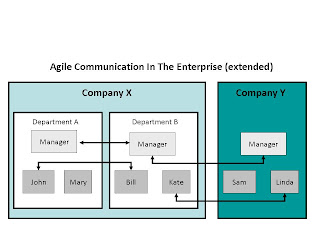
Finally had time to read another great post (and all the comments!) by Alex Iskold on ReadWriteWeb . It’s about “The Social Enterprise - What works, and What Doesn’t” . This post gives a good overview of why and how companies should use social media (internally and externally). I agree with most of the post. I do have a couple of comments and questions: 1. Alex ask “Do corporations need social networks?” I would say ‘yes’ because companies are inherently social, or at least, they were when they started. Companies are built up by individuals that got together because they have/had a shared concern. If these individuals are not social, there would be no enterprise. Or do you mean ‘social network applications’? 2. I missed one (to me) important dimension in Alex’s “Agile Communication in The Enterprise”. It focuses on one company with two department. But isn’t the real issue for companies a little bit more complex? And isn’t this a very important reason to devise new work...

IT resources focused on (un)structured data

With respect to my post about structured and unstructured information management Gartner predicts this: By 2011, IT will allocate 75% of information management (IM) resources (people, systems and software) to integrate and analyze a blend of traditionally structured and diverse data types, whereas today 75% resources are focused only on structured data. Source: Predicts 2008: Information Infrastructure Will Help Master Chaos (Gartner Research, G00153199, Dec. 5, 2007)

An architecture to Manage Structured and Unstructured Information

Relating to this post by Column Two , which is more about web content structuring/un-structuring, I'd like to ask you the following questions. But first I'll give you some context. Introduction Product research, development, engineering and manufacturing is an interesting process. To certain extent it is structured and follows agreed upon work flows. On the other hand much is done in an ad hoc and unstructured way. An important part of product research, development, engineering and manufacturing is information management. To design a product information must be gathered, structured, distributed, searched, etc. Over time a clear description of this product (part) is stored, versioned, communicated, etc. These facets of data, document, information and knowledge management are also sometimes very structured, while in other parts of the process totally unstructured. Most companies manage structured data, documents and information fairly well (in PLM and ERP systems). Most inf...

Video on Office Live Spaces

Scobelizer has an interesting video on Office Live Spaces . Nice video! I was wondering how this relates to Groove and Sharepoint? Is this just for "smaller groups"? Does anyone know? Also refer to TechCrunch's review .

Blogging transparency

Hope you all had wonderful holidays! Back to blogging! Some time ago I posted on Jeremiah Owyang's blogging approach . I wrote a.o.: What I was thinking though was: isn't it too bad that these draft posts aren't visible in some way from the start? I'm not saying every idea should be public (total transparency), even if that is possible. But in companies it can be very useful to know that somebody's thinking about something and working on an idea. The 150 draft posts show that Jeremiah has loads of ideas that are not really ready to publish, but eventually they will or several draft posts will be merged into one. I think lots of people can relate to this situation. And a blog is a wonderful place to work on, store and publish them. So, wouldn't it be nice to have a way to publish a draft post (just the title for instance) to give your colleagues (or the world) an idea of what you're thinking about? Well at least Jeremiah liked the idea and sent all his draft...

Implications of the Latest PLM acquisitions

Interesting article about the latest PLM (Product Lifecycle Management) acquisitions and their implications. Although this article is focused on the automotive market, it has broader implications to other market segments. A couple of interesting remarks from the article: You could argue that now everybody has a few less choices; the market has consolidated to a few major players. (...) PLM technology is becoming less of a factor. PLM depth of coverage, how rich the solution is, is becoming more of a factor. And I think this remark about Dassault is most important. Being able to support multisite development, engineering and manufacturing is key. Plus being able to collaborate with non-engineers on one platform. Squire says MatrixOne lets Dassault grant access to detailed product definition to virtually anybody in the extended enterprise, and to standardize business processes that use that information across disparate groups, including non-engineers and other people not necessarily...

Enterprise 2.0 Market Map

Image
FirstPartner is: ...a fast growing strategic marketing and research agency focused on IT, telecommunications and Media sectors. Not too long ago they released an insightful "Enterprise 2.0 Market Map" . You can download it for free. The overview it gives is nice. I also like the fact that it incorporate the "1.0" tools. What I question though is mixing up "collaboration tools" and "document and records management tools". Actually, "collaboration tools" are not mentioned. For instance, Sharepoint is labelled a "document management tool". I would say Sharepoint (and IBM Workplace to mention another one) is about supporting (document) collaboration. It can only be used for light-weight document and records management. Furthermore, an important category is also missing. CM, CRM and ERP are mentioned. But tools to support Product Data/Lifecycle Management aren't (e.g. Siemens UGS ).

Océ's Document Services Valley

It's public! And I'm really excited about it! Océ is setting up the Document Services Valley. Here's (part of) the press release : Océ N.V., a prominent global leader in professional printing and document management, today launched Document Services Valley in its Dutch home town of Venlo. Document Services Valley will focus on the research and development of document related services. In this new Valley , Océ intends to join forces with authoritative business partners and is currently in discussion with several. Partnership is key to develop the new services and test them in the market as quickly as possible. Effective 2008, some 50 experts will be employed by Document Services Valley . Demand for a document management resource such as the Valley has risen considerably and is attributable to various business trends such as new corporate governance legislation like Sarbanes-Oxley . UPDATE Oct. 15, 2010: Please refer to the Document Service Valley website for more informa...

Document Management System in Engineering

Found this interesting article on document management in Engineering . You don't find articles on this topic too often. And if you do, they'll mostly be about handling structured, product-data. This type of data/information is usually managed in Product Lifecycle Management Systems or Product Data Management Systems. But where does all the other important, contact information go? The type of information usually called 'unstructured information'. This article addresses both types of information. Basic requirements for managing unstructured information are: Ensure easy retrieval of and access to relevant documents by authorized (and only authorized) persons Make collaborative working an efficient and effective process Preserve the documents, particularly those that make up the knowledge base, free from damage and loss for a long time Exercise proper version control to avoid erroneous use of obsolete documents and for keeping track of different aspects However, I do miss a...