Posts

Showing posts with the label email

A World without Email by @elsua #intra13

Image
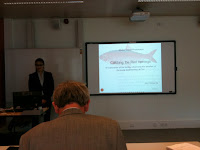
We started out the workshop with sharing who we are and how we cope with email. Surprisingly most says they cope with email quite well and don't experience email as a huge issue. But all would like to use email in a better way and get others to do so as well. All participants have some kind of collaboration tool inside their firewall (not saying it's used well or not). Luis Suarez finds many high-level manager balk when they hear the word 'social', so he uses 'open' more. He stresses that email is a great way to share information. Which is true, says Luis. But you must add: in a silo. And his 'war' on email is not about killing email but repurposing it. Luis asks why colleagues of the partipants are reluctant to use (internal) social/open tools: time no big value loss of control relevance of information convenience availability security resources governance no fame what's in it for me? over-sharing extra tool not business critica...

Emailing with @elsua?

Image
You all know +Luis Suarez , right? The guy from IBM, that live on the Canary Islands and has declared war on email . Well recently I wanted to get in touch with him to discuss an opportunity that popped up. Contacting him is easy, right? He’s all over social media. Just DM him on Twitter , send a message via Google+ or Facebook. LinkedIn will do as well. I thought I’d share how it went. Did I seduce Luis to hand over his email address to me?  But what to do if you want to send him a longer piece of text? Do you request for his email address? I was tempted to but refrained to ask because I knew I would be whipped by him. ;-) So I reached out to him via Twitter (direct message) and asked if we could call sometime soon. That was possible and we had a chat. But, still, I had to send him more information about the opportunity, about 10-15 lines of text. And I’m not going to chop this into 140 character messages. LinkedIn could work, but feels like email. I’m not connected to Luis i...

What's the real issue with Information Overload?

What's the real problem underlying information overload? Nathan Zeldes has been finding answers to this question for years. Recently he wrote a must-read post on the answers he found. There are all kinds of reasons we keep on using email in an unproductive way. But the underlying issue, according to Zeldes, is mistrust . To solve the information overload problem within organizations we need to address this "dark side" of overload. If we don't we'll never structurally solve the problem. Address this dark side and change the underlying culture, Zeldes advises. I agree this is a way to fundamentally root out mistrust. But what if this is not possible? What if the company just doesn't see the problem and therefore does not want to spend time on this extermination process? I think every person can start by settting an example. Be counter-cultural! Show how the way you use email is more effective and productive. It's the long bottom-up approach, but this roa...

Email integrated with Social Software

James Dellow has a nice post researching the history of email and why email is so successful. More importantly he wonders what this means for social tools and their success. He concludes his post with the following: Enterprise social software can also learn some important lessons from email: We need interoperability between enterprise social systems. Users prefer standardised interfaces. It needs to be cost effective to own and operate. Far from being a nemesis, email and enterprise social software are more likely to form a strong symbiotic relationship. I've been thinkings and blogging about this topic quite a bit as well. I did research and product concept development on document management tools in the past. One of the things we said back then is: integrate document management into email. I think this principle still applies. I also think the killer social tools will be deeply integrated into/with email. For that reason I think Google+ has a good chance of winning ...

Is email dead? Or is it moving to social networks?

Image
Is email here to stay or will it die? Will it die because social media is here or will something else replace email? Recently Steve Dale wrote an interesting post about this topic. It's titled 'Email is dead: long live email!' . It was discussed on G+ and the blogpost itself has many interesting comments. I thought I'd share my comments here as well. Please read Steve's post first. I think it's an important post for social business people. Steve lists several reasons to use (and keep on using) email: Email arrives near instantaneously. It can be accessed from almost anywhere. It brings not just text, but pictures, documents, links, and more. Email is great for non-urgent communication. Things that don’t require an immediate response that others can deal with on their schedule. Email can provide a powerful documentation trail. Unlike text messages or phone calls, email provides an authenticated audit trail of past communication. It is hard to deny pas...

iPad experiences

Image
I love my iPad ! What a wonderful gadget it is! When we got it (with a newspaper subscription) I was wondering: Is it really worth it? I have an iPhone and a laptop, what do I need an iPad for then? But, again I experienced that using is believing .The iPad (- I have the iPad1) fits perfectly between the iPhone and laptop. In lots of cases it takes over usage time from the iPhone and laptop. For instance, reading email is great on the iPhone and the iPad. Instant-on is a killer. Even my wife hardly fires up the (Windows) laptop to process email. Although typing longer emails is still done on the iPad, most emails can be processed by a quick and short reply using the iPad. Reading news and feeds is wonderful on the iPad as well. Apps like Flipboard are mindblowing. I'm amazed by how quickly I can go through feeds, tweets, etc. using Flipboard, compared to Google Reader or Twitter itself. And I love the way news is presented. It feels and looks right. And I'm sure we haven...

No Reply

Image
Maybe I shouldn't depend on email as much as I do, like Luis Suarez is telling us . But there's something about email that surprises me. When I send emails to people, ending with a clear question and deadline, many don't reply at all. Why is this? A week or a month later I have to get back to them and ask them again (yes, I keep track of the emails I need to get a reply on ). Then they usually send a reply back right away... So it is possible to get a reply back quickly. I know people are busy. I am too. And I don't assume everyone will be waiting for my email and send back a reply in less than a day. I don't mind if I have to wait. As long as you know the reply/answer will come around sooner or later. Walking up to the person or calling him/her helps of course, if possible. So, how do I handle email? I basically apply the Getting Things Done rules: if I can answer within 2 minutes, I reply right away. Most email fits in this category... If it takes longer I pl...

The Difference Between Email and Social Bookmarking

Image
Well, Arzu just finished her Masters thesis last week with a good grade! As you know I posted   several snippets from her work. Soon her thesis will be public for you to read. I think she did a really good job and the results, though focussed on social bookmarking, are interesting in general if you're interested in technology and social media adoption. But how do you share bookmarks? Do you use a social bookmarking tool? My experience is not many people use a social bookmarking tool. Of course they bookmarks stuff and save the bookmarks in their browser. Hardly anyone knows you can share them publicly as well. At least that's the experience I have. I give workshops about social media and I always have a slide about bookmarking. I've been tempted to leave it out. Because every time I get to that slide and ask how many of them know what social bookmarking is and use it, hardly anybody does. The ratio is 1-2 out of every 10 workshop participants. Is this   the reason w...

Email Guidelines: Do You Have Them?

Image
Recently the old debate popped up again: what to do and not to do with email? A colleague started a rant about colleagues who continuously CC lots of people. Another chipped in about colleagues using 'reply all' too much. Ah, the beauty of collaboration! ;-) Doesn't it all come down to agreeing how we work together? For this reason many companies set up a 'code of conduct' (or something like this). We have one too. Strangely enough these 'code of conducts' doesn't say much about using email for instance - as far as I know. Some time ago we did an internal workshop with Novay about email productivity. One of the assignments was to come up with 'email guidelines'. The great thing is consensus about the 10 email guidelines we all would adhere to was easily found. (By the way, these guidelines were only approved by the workshop members, not by the whole organization. We still have a way to go...) So, does your company have email guidelines? If...

Workshop Productive Knowledge Work

Besides workshops about social media I've also been giving workshops about Productive Knowledge Work. It's a lot of fun. And I'm surprised at how many people are looking for ways to become a productive knowledge worker. One theme that is addressed by the participants in almost every workshop is 'email guidelines'. They say: We should agree not to 'reply all', have clear email subject lines, etc. I shared the slides I use for you. If you have comments or questions, I'd love to hear them. Productive Knowledge Work Workshop View more presentations from Samuel Driessen . Tags van Technorati: gtd , getting things done , productivity , knowledge worker , email

Your Email Client as the Ideal Enterprise 2.0 tool?

Image
Tom Kronenburg of CapGemini recently wrote an interesting post on the (Dutch) blog Frankwatching . His post was titled: 'Microsoft Outlook the best Enterprise 2.0 tool...' Nice title eh? At least Luis Suarez won't agree... ;-) If you want to read the whole post, go ahead and translate it with Google Translate . In short Tom's point is: the only successful enterprise 2.0 tools relate directly to email/the email client. This is an interesting thought! His post provides lots of input for discussion. I commented on his post and would like to pass my remarks on to my readers as well, and elaborate a bit. In the first place, I agree with his thesis that web 2.0 concepts and tools should integrate well with the primary workplace of knowledge workers. Which is email mostly. Email is the knowledge worker's habitat . In whatever way you look at it, if you don't integrate with the email client the new tool will be perceived as 'an extra tool'. And in my e...

Taglocity for Files?

I forgot to post an idea on how Taglocity could become even more useful (for me). It would be nice to be able to tag/label files too (straight from Outlook and in Explorer). I know Vista supports tagging of files (I use Vista at home and XP at work), but I don't find the tagging very easy and user-friendly. Is Taglocity thinking of moving in this direction? Tags van Technorati: email , productivity , social networking

First Taglocity Experiences

Alright! Not too long ago I said I would start using Taglocity . And, of course, I promised to tell you more about my experiences using it. Well, here goes! The strange thing is not too many people seem to be using Taglocity. At least not the people in my network. Lots of them use Xobni , as I did too. I tweated my network , searched Twitter , Googled a bit and found their isn't a whole lot of buzz on Taglocity yet. Well I guess I'll have to create some and lead the way... ;-) Ok, now about Taglocity. As I said I really enjoy Gmail functionality. Taglocity brings this to Outlook. And it works for me. I really enjoy adding labels to my email. I still put mail in one of the 6 folders I have (of which the biggest one is 'Deleted items'). But I now also label them. This makes finding my email back much faster. And I don't have to be to anxious to put the email in the right folder. The search speed of Taglocity is good enough. In practice I switch between Outlook ...

Stop Using E-mail

Nice presentation (9 min.) by Luis Suarez to whom I've been pointing regularly on my blog. This is his presentation at the Web 2.0 Expo in Berlin (added in below). It gives a good overview of how he's trying to stop using e-mail for the wrong reasons and what he experiences doing this. I've asked the question before, but I'd really like to hear more from Luis about the time he used to spend on email and the time he now spends on email and the social tools. (Something for the Sweettt podcast , Luis?!) Also relate to his posts on day 1 , day 2 and day 3 of the Expo. Tags van Technorati: email , information overload , web2.0 , enterprise2.0

Trying Taglocity: tagging Outlook

Well, just ran into Taglocity . I read through their site to see what they offer. I must say it all sounds very interesting. I'm curious how Taglocity compares to Xobni . I've been using Xobni for some time now and am pretty enthusiastic about the tool. Is Taglocity even better? So, I'm de-installing Xobni to try Taglocity. (I don't want 2 sidebars in my Outlook and I'm don't want to try them both at the same time.) One think I'm really curious about is tagging in Outlook like in Gmail. That would be great! (I use Outlook 2003 and heard that 2007 has tagging functionality.) So, I'll be using Taglocity for the coming weeks. I'll let you know what my experiences are. My evaluation questions are: how does Taglocity compare to Xobni in general? is Taglocity as social as Xobni? are the Taglocity tags as good as Gmail's? can tagged emails also be retrieved after they've been archived and/or moved? is Taglocity secure (als...

On Breaking the E-mail Compulsion

Often the blogosphere just points you to great posts. Luis Suarez pointed us/me to this great post on email overload on the tfpl blog . It is titled "Breaking the e-mail compulsion" . It passes on some interesting facts about email use and addiction. It goes on to give us some good email tips (which I apply already). But what really triggered me was the big question: The challenge that I would like organisations and vendors to address is this: How do we enable colleagues to generate, send and store an important communication about a project within the same application that holds the rest of the documents, communications and information relating to that project? I can't tell you too much, but colleagues of mine addressed this issue and answered this question to a large extent. I pointed to a paper on this work here . And I hope to publish another paper on this topic with them soon. So, keep in touch! "Context" and keeping information "in context" i...

Email and Broken Business processes

Image
Luis Suarez pointed to an interesting post "Broken business processes contribute to our email overload" . The core of the post is: Socialtext has connected the dots between a few reports to discover that a great deal of our email comes from handling exceptions. Because business processes don't have a system to translate them into practice, we spend more than a quarter of our day emailing about the exceptions to the business process rules. Worse than the volume of email is the amount of mental energy required by each email recipient, ergo worker, to parse each exception and determine what to do with it. E-mail was once intended to increase productivity and has now become so voluminous it is counter productive. Basex determined that business loose $650 billion in productivity due to the unnecessary email interruptions. And, the average number of corporate emails sent and received per person per day expected to reach over 228 by 2010. Email overload due to broken business p...

Stop using work email (2)

Back from vacation (that's why blogging has been slow, although I've been using automatic posting - works wonderfully!) and still the first to comment on this interesting post about a.o. Luis' venture to stop using email ... After another week of about 30 mails Luis remarks that lots of these emails are related to scheduling. He writes: Yes, indeed, I am talking about e-mails that are related to scheduling, setting up and participating in conference events, customer meetings / workshops, specially when it is to show my own experiences on this new reality itself. I am thinking that if I would be able to find a way to reduce those I would be getting my number of incoming e-mails down to 15 to 20 a week. If not less! Yes! As massive as that!!! This triggered me. This implies (logically) that his list of email per week should also include information about the time he has to spend on an email. If you get 30 mails you can delete after just accepting the meeting request for insta...

Stop using work email

Every now and then I pointed you to Luis Suarez's very interesting experiment to stop using work e-mail. He's in his 12th week now and things are looking good! He and Jon Mell got together to discuss this experiment and its consequences. This resulted in an interesting podcast. You can find it on Luis' or Jon's blog . There's also another podcast series on Luis' experiment here . These podcasts nicely give an overview of the stop-using-email test (if you haven't kept up with it) and ponders on its potential.

Add Holidays to Your Calendar in Outlook

BNET Business Hacks pointed to this useful Outlook feature I didn't know existed: You can add a country's holidays to your Calender.