Posts

Showing posts with the label social networking

Asking more questions

Image
Why don't we ask more questions? Or maybe you do, but I should ask more questions. Recently I encountered a problem I couldn't solved. So I reached out to colleagues to understand if they had answers. They didn't. Then I thought: should I post my question on Yammer or Twitter ? Yammer could work but I had basically already asked the relevant experts within the company so I thought that would be a waste of time. Then Twitter maybe? To be honest, I find the engagement on Twitter pretty low. When I started using Twitter asking a question could get you lots of answers. Now Twitter is more of an update platform and less of a question platform. At least that's how I see myself and others using it. Well, then I thought I'd post my question on Quora . Good 'old' Quora. I've always loved Quora. A very focused and smart platform with lots of people just waiting to answer your question. And Quora suggests potentially relevant people from your network and ...

A World without Email by @elsua #intra13

Image
We started out the workshop with sharing who we are and how we cope with email. Surprisingly most says they cope with email quite well and don't experience email as a huge issue. But all would like to use email in a better way and get others to do so as well. All participants have some kind of collaboration tool inside their firewall (not saying it's used well or not). Luis Suarez finds many high-level manager balk when they hear the word 'social', so he uses 'open' more. He stresses that email is a great way to share information. Which is true, says Luis. But you must add: in a silo. And his 'war' on email is not about killing email but repurposing it. Luis asks why colleagues of the partipants are reluctant to use (internal) social/open tools: time no big value loss of control relevance of information convenience availability security resources governance no fame what's in it for me? over-sharing extra tool not business critica...

Emailing with @elsua?

Image
You all know +Luis Suarez , right? The guy from IBM, that live on the Canary Islands and has declared war on email . Well recently I wanted to get in touch with him to discuss an opportunity that popped up. Contacting him is easy, right? He’s all over social media. Just DM him on Twitter , send a message via Google+ or Facebook. LinkedIn will do as well. I thought I’d share how it went. Did I seduce Luis to hand over his email address to me?  But what to do if you want to send him a longer piece of text? Do you request for his email address? I was tempted to but refrained to ask because I knew I would be whipped by him. ;-) So I reached out to him via Twitter (direct message) and asked if we could call sometime soon. That was possible and we had a chat. But, still, I had to send him more information about the opportunity, about 10-15 lines of text. And I’m not going to chop this into 140 character messages. LinkedIn could work, but feels like email. I’m not connected to Luis i...

Email integrated with Social Software

James Dellow has a nice post researching the history of email and why email is so successful. More importantly he wonders what this means for social tools and their success. He concludes his post with the following: Enterprise social software can also learn some important lessons from email: We need interoperability between enterprise social systems. Users prefer standardised interfaces. It needs to be cost effective to own and operate. Far from being a nemesis, email and enterprise social software are more likely to form a strong symbiotic relationship. I've been thinkings and blogging about this topic quite a bit as well. I did research and product concept development on document management tools in the past. One of the things we said back then is: integrate document management into email. I think this principle still applies. I also think the killer social tools will be deeply integrated into/with email. For that reason I think Google+ has a good chance of winning ...

Re: Which social media do millenials use?

Image
Recently I had the privilege to give a guest lecture at the Hogeschool Arnhem & Nijmegen (college-level) about Enterprise 2.0. Just like  last year  I asked the students which social media tools they use and why. I like asking them this question, because it gives me some insight in adoption rates of tools and usage patterns. Last years results can be found here . I'll share this year's results below. Of the 24 students I had in my classes: 24 have a Twitter account, 6 actively use it and 2 others only consume tweets. 24 have a Hyves account (Dutch social network, comparable to Facebook), 1 uses it actively and some go there every now-and-then. Facebook is clearly taking over Hyves, with 20 accounts in the classes and they use it actively. 14 only consume Facebook updates. Only 2 have a Foursquare account and use it actively. 6 have a Google+ account and none of them use it. LinkedIn: 16 have an account, 5 use it actively. They all have to blog for these class...

Do you have more than 150 friends?

Image
Do you know more than 150 people? You probably don't. And do you have more than 150 friends on Facebook and followers on Twitter? You probably do. But are they really your friend? Do you really know all 150 of them? I don't think so. A long time ago I ran into Robert Dunbar's research on social networks. I wrote several posts about Dunbar's number and have been collecting interesting links as well. Just recently Dunbar was interviewed   by Technology Review about his number and social networks. What is Dunbar's number about? His research basically showed... ...that humans have the cognitive capacity to maintain about 150 stable social relationships.  The first time I read this I thought: What?! But it's is now my experience this is true. Even for social media friends and followers. I follow way more that 150 people, but I know and truly engage with 150-300 of them. Of course Technology Review was also wondering if Dunbar himself still thinks his...

Is email dead? Or is it moving to social networks?

Image
Is email here to stay or will it die? Will it die because social media is here or will something else replace email? Recently Steve Dale wrote an interesting post about this topic. It's titled 'Email is dead: long live email!' . It was discussed on G+ and the blogpost itself has many interesting comments. I thought I'd share my comments here as well. Please read Steve's post first. I think it's an important post for social business people. Steve lists several reasons to use (and keep on using) email: Email arrives near instantaneously. It can be accessed from almost anywhere. It brings not just text, but pictures, documents, links, and more. Email is great for non-urgent communication. Things that don’t require an immediate response that others can deal with on their schedule. Email can provide a powerful documentation trail. Unlike text messages or phone calls, email provides an authenticated audit trail of past communication. It is hard to deny pas...

LinkedIn as your intranet?

Image
“Why can't we use LinkedIn for our intranet? At least it works, our intranet doesn't .” Maybe you considered this or heard it in your organization. The question intrigues me and I think we will hear it more and more in the coming years. What do you say in response to this question as internal or external consultant, Communications or IT manager? I'd like to share my thoughts in this post. Dissatisfied about IT The intranet is changing rapidly. The internet provides all kinds of free tools, like Dropbox, Yammer and Google Drive. More and more people are getting used to sharing (versions of) documents, online collaboration, sharing short messages, setting up and maintaining a personal profile, etc. Employees are often dissatisfied about the internal IT-tools and content-focused intranets. These tools cannot compete with the functionality we have on the internet. Free tools as intranet More and more employees are openly, and sometimes secretly, using free internet too...

Choosing the right social tool - Reflecting on the #SocialNow conference

Image
Many companies are looking into social tools for their internal organization. Lots of others just select what related companies have chosen. Hoping this is the right choice. As with selecting content management systems, many struggle to select a social platform. There are so many tools out there and they all say they can help you support internal networks. How to choose the right one? Is there a right one? Does the success of a tool elsewhere mean it will also be successful in the company you work for? The Social Now conference in Porto (June 26-27), organized by Knowman , addressed these questions. And it did so in a unique way. Basically the idea was to have social tool vendors present based on a concrete company case that wanted to move forward in knowledge sharing, idea management and collaborative project work. The vendors were asked to share their approach in 20 minutes and then an expert panel helped the company ask the right questions to the vendors. Many brave vendo...

Social technologies are extending organizations

Image
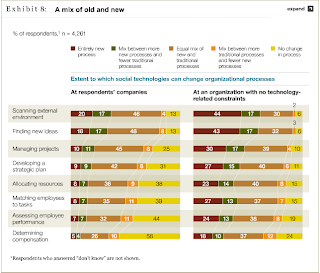
McKinsey has been following the social business movement for some time now. And they're following to see if it can live up to the expectations. Recently they published the results of their 5th annual survey under 4200 global executives. The polled them how their organizations use social tools. The finding of the report are interesting. There's clear progress: social tools are being used more and more and in more effective ways. When adopted across the networked enterprise and integrated in work processes of employees, clear benefits are seen. There's a boost in financial performance and market share, which relates to the results of previous surveys. However not many companies are fully networked, meaning they are internally and externally networked. One of the most interesting things I read in the report was the fact that executives believe if organizational barriers to social tools diminish, they could transform the core business processes. This is a big stateme...

Fire all the managers?

Image
I listen to the HBR Ideacast regularly. Recently Gary Hamel was interviewed about his HBR article 'First, Let's Fire all the Managers' . As you may know Hamel has devoted a large part of his life to thinking about better ways to organize and manage companies. What kind of management (if any) does this time period need. Of course, Hamel goes into why he wrote an article about this topic. But to me the most interesting part was that Hamel provides examples of companies that don't have management. When I was listening I caught myself thinking: Yeah, less management would be great, but can we really live without them? Hamel shows it can be done. He points to one company called Morningstar for instance. Very interesting and thought-provoking! What do you think? Can your company or could you live without management?

Linking Strategies in LinkedIn

Image
How do you use LinkedIn ? Who do you connect to? Do you use LinkedIn Groups? This post on the NextWeb triggered me to answer these questions publicly. Resume LinkedIn is an interesting platform. I've been using it for several years now. At first I basically uploaded my resume to LinkedIn. I hardly visited LinkedIn after that, except for excepting link requests. Some time after that LinkedIn introduced Answers . I followed several topics there, but stopped after about a year. The quality of the questions was horrible and it seemed I didn't get anything back from the answers I gave. Groups I also joined several LinkedIn Groups. Groups is interesting and it keeps me coming back to the LinkedIn site. Right now I'm following 27 groups, mostly in my area of expertise (intranet, social media, knowledge management, enterprise 2.0, social business). Most of the groups have interesting discussions. The update in my email every day helps me keep up with what's going on i...

More Structure in Knowledge Work

Image
A while back Thomas Davenport wrote an interesting McKinsey report 'Rethinking knowledge work: A strategic approach' . It's a thought-provoking piece. It goes against the trend to say knowledge workers should be left alone, they're smart and know what to do. Davenport says we should provide more structure to knowledge work. Providing knowledge workers "well-defined context of tasks and deliverables". It's time for companies to develop a strategy for knowledge work - one that not only provides a clearer view of the types of information that workers need to do their jobs but also recognizes that the application of technology across the organization must vary considerably, according to the task different knowledge workers perform. Davenport clearly also looks at the down-side of the free-access model for knowledge work. Are all knowledge workers really up to their task? Davenport clearly says 'no'. There are different levels of knowledge work tha...

Social Business Transformation: Why?

Image
CapGemini is a company positioning itself as a social business expert. Recently they published a whitepaper about social business: 'Social Business Transformation. How customers change your enterprise DNA' . It was written by Rick Mans and Joel van Gogh. The whitepaper is an interesting read. However, I left me with one big question. Why? In the management summary and in chapter 1 I read lots of things I agree with. But I think people will ask 'why?' after reading the paper. Why is this transformation to social business necessary? Why are customers interacting in different ways with businesses? Why are their expectations changing? Is social really a "new" way of interacting? And why is the decision process changing ? Is it really? I think this report would have been better if these answers were answered. I understand this first chapter, as the whole whitepaper, have to be "brief" as it says. But I'm also convinced the underlying concepts ...

A Brief History of the Corporation

Image
There are lots of good bloggers and blogposts out there. But every now and then I run into a post that is just great. This is one of them: A Brief History of the Corporation: 1600 to 2100 by Venkatesh Rao. It's a long post! So, make sure you have some time to read and process it. Why do I think this post is so interesting? Well, there's been lots of debate about what social media means for traditional business. Will it change or is it changing the way we do business? Is the traditional, hierarchical way of organizing companies sustainable? Is social media correcting the industrial revolution? Or should we say 'the industrial interruption', like 'The Cluetrain Manifesto'  says. Is this enterprise 2.0 or social business? Much has been and is being written about this topic. Just think of the books 'Wikinomics' , 'Macrowikinomics' and 'The Cluetrain Manifesto' itself. So, what is this post about. In it's own words: The Age ...

Is an Organization a Hierarchy and/or a Network?

Back to work after a wonderful vacation in the US! Really enjoyed being there. My sister lives there. We went to the Gulf of Mexico with them and stayed there for a week. And we also travelled to Washington D.C. Went to the Museums in D.C. (we had already 'done' the monuments in a previous trip), went hiking in Shenadoah National Park, etc. Now back to work. Worked through my email, feeds and tweets. One post I saved to read was  this interesting post by prof. John Kotter, Hierarchy and Network: Two Structures, One Organization . A must-read for all social media and social business people! Lots of discussion there. I also commented on the post. I wrote: Wow, lots of discussion here. I liked the post as well. I blogged about this topic a couple of times. I agree with some of the comments made stating the hierarchy and business is older than the 19th century. I do think you can say the 19th century made hierarchy the way to go. I think this is one of the reasons social media is...

The Netherlands: The Social Networking Country

Pretty proud to be Dutch: The Netherlands Ranks #1 Worldwide in Penetration for Twitter and LinkedIn . Impressive numbers.

Productivity, Multitasking, and the Death of the Phone - HBR IdeaCast

One of the podcasts I listen to is the HBR Ideacast. They have lots of interesting talks with people. Sometimes these talks are related to articles published in HBR. Recently they interviewed Sherry Turkle of the much-debated book 'Alone together'. You can find the podcast here: Productivity, Multitasking, and the Death of the Phone . It's an interesting podcast to listen to and think about. I understand the problem she is seeing and describing (although I still have to read the book). I understand she is worried about it too. But every time I read about her book and listen to what she's saying I think: Shouldn't this problem be addressed by helping young and old people understand the new web and using it in the 'right' way? For instance, help people filter the web, search the web, understand web privacy and build networks using the web. I see a huge need for this around me. And I don't see many schools (and parents) stepping up to this task. I liked Tur...

Share to connect: Inside Nokia's Program to Connect Customer Insight with Business Performance by Ming Kwan @mingk #sbs2011

Image
Share to Connect is about aligning our organization, Nokia , and the way we work with what we promise as a brand, says Ming Kwan . Their objective was to maximize the brand's productivity by turning it into a conversational brand. Transparency, listening and coordination will enable the organization to gain momentum in an era of exchange. Share to Connect consists of 3 main elements: organizational optimization workforce collaboration customer participation The main issue they are trying to deal with is information overload. They collect lots and lots of information. Their big issue is generating insights from all the information. So they have this idea/pilot called Socializer. An aggregation and analysis platform connecting the streams from the (social) internet to the organization. Socializer is a social action framework (with semantic analysis), it's internal and external, it's focused on actionable insights, it's real-time and employees can claim actions. Objectives...

My Slides for the Web24Business Brainstorm #w24brainstorm

A couple of days ago I gave a talk about (some of) my Enterprise 2.0 experiences at the Web24Business Brainstorm . Saskia Lammers of the Temporary Art Center Eindhoven ( TAC ) was also invited to speak. She told about her work in developping a new social website that would support the community of artists. It was interesting to see the idea of the website consisting mostly of content from elsewhere, like Facebook, Youtube, etc. My 20-minute presentation gave a short overview of the work that was done in Océ in the Enterprise 2.0 space. And some of my insights. Here are my slides : Enterprise 2.0 Experiences View more presentations from Samuel Driessen And, as always, comments are more than welcome!