Posts

Showing posts with the label expertise location

I’ve seen the future and (part of) it’s Qbengo

Image
In the past I’ve written quite a bit about expertise location and knowledge mapping . Expertise location is about supporting people to find people with certain expertise they’re looking for. In larger and multi-nationals organizations this is a big issue. One aspect about expertise location is also finding out where the person is. This can be a static location (e.g. the person works in room 3, building 4). This is difficult enough, but it can be done as I wrote some time ago. However, the workforce is more mobile than ever. Less and less employees have a fixed space they’re working in daily. They work in several rooms in an office during the week, they work from home, in the car, etc. Supporting expertise location in this context is even harder. In theory it can be done. I wrote about this as well. But I never saw a company actually connect the dots and make it work. Until recently. I had the pleasure to visit Qbengo . Qbengo is currently focused on connecting people at larger confer...

A Google Glas intranet?

Image
Most people know the history of the intranet . And if you’re older you will have experienced its history. Many organization that have had an intranet for years are looking for ways towards a modern and future-ready intranet. But what is the future of the intranet? Many intranet experts and organizations are thinking about this question. Are we eventually going to be apply to wear the intranet? From intranet to social intranet  There’s lots of talk about using social media within organizations. In short this is also called the ‘social intranet’. The intention is to have an intranet that is more than most are used to: news, procedures, who-is-who and the restaurant menu. A ‘social intranet’ should make us forget the old intranet. The old intranet that often hardly supports the way employees do their daily work.  From intranet to digital workplace  For this reason the new intranet is also called the ‘digital workplace’ more and more. A new name to help us forg...

Another step towards internal maps

Image
Outdoor maps are great. Google is doing a wonderful job with Maps . But what about indoor maps? I've been tracking posts about this topic for some time. And just recently Google announced it's taking Google Maps indoors . Here's a short video about his initiative: I think this will have huge implications for companies as well. Just think about adding maps to your internal intranet employee directory.

Social technologies are extending organizations

Image
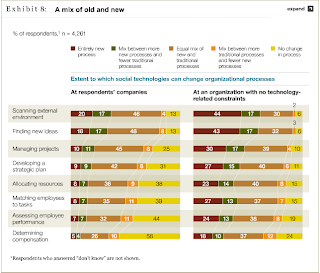
McKinsey has been following the social business movement for some time now. And they're following to see if it can live up to the expectations. Recently they published the results of their 5th annual survey under 4200 global executives. The polled them how their organizations use social tools. The finding of the report are interesting. There's clear progress: social tools are being used more and more and in more effective ways. When adopted across the networked enterprise and integrated in work processes of employees, clear benefits are seen. There's a boost in financial performance and market share, which relates to the results of previous surveys. However not many companies are fully networked, meaning they are internally and externally networked. One of the most interesting things I read in the report was the fact that executives believe if organizational barriers to social tools diminish, they could transform the core business processes. This is a big stateme...

Successful Intranet Search by Martin White @intranetfocus #intra11

Image
Search has been a hot topic in the intranet space for a long time. Why can’t I find what I’m looking for inside the company, just like with Google on the Internet. Martin White ’s breakout at the Intranet Conference ( Congres Intranet ) was about this topic and want to help us improve intranet search. White started out by asking which search engine we used. A long list of search platforms is mentioned, ranging from open source search technology to Sharepoint search. Not many participants have the same engine. This illustrates one of the points White wanted to make. Search isn’t easy. It not easy on the internet, and it’s hard on the intranet as well. He shows how different the search results are. This is not helpful for users and it makes search unnessissararily complex. This is one of the reasons user go for the easiest route on the internet: just use Google. However inside companies one often cannot easily choose this route . On the internet you mostly know what you are looking for...

LinkedIn Skills

Looked at LinkedIn Skills . Interesting extension to Linkedin. Although it isn't really new functionality. All users could already fill in the expertise they (think they) have based on their work experience. To me this is one of the limitations of LinkedIn. Isn't it much more interesting to hear what others think of you? What expertise do they think you have ? Who is the go-to person when you need someone with skill x? LinkedIn Skills basically only says: I think I'm the person you're looking for.

Re: Expertise Location by @mikegotta

Image
Michael Gotta of Cisco wrote an interesting post some time ago about "Expertise Location: Don't Forget Process & Cultural Factors" . He relates to the fact that Enterprise 2.0 is often sold by saying that social tools help find experts in the organization more easily. However what's the assumption underlying this? The general assumption includes two primary ways of identifying "experts". The first method assumes that employee use of social tools (e.g., blogs, wikis, micro-blogging, communities) and social applications (e.g., ideation), enables their talent and business insight to be more visible and therefore more discoverable by co-workers. The second method revolves around the employee profile created as part of an enterprise social network site. It is assumed that employees will readily create and maintain rich profiles where they willingly share information about their job history, interests, hobbies, education, and areas of expertise. Rich emplo...

An implicit expertise network / IBM´s Expert Network on Slideshare

Luis Suarez recently pointed me to this. IBM set up an Expert Network on Slideshare , giving us a way to see all the slides produced by IBM-ers. Adam Christensen has a post explaining why this was done . This got me thinking. I think this is a smart move.  Isn’t this a great way to implicitly show the expertise of IBM-ers? Of course LinkedIn tries to do the same, the other way around. You set up your profile. And you can connect Slideshare to your profile. Problem is, nobody says that profile is correct. And clicking through to the proof (e.g. your presentations) is not that easy. Furthermore you can´t see if that person is the only expert in that organization or the organization as a whole has expertise in a certain area. I think if you’re looking for someone from IBM to help you out, the Expert Network on Slideshare will get you to the right man/woman much more quickly. What do you think of this move? And do you think such a network in Slideshare is a better expertise locat...

Social networking with Sharepoint 2010 @ ABB Global #epem

Next speaker: Stein-Ivar Aarsaether, ABB Global Web Management. ABB is a global leader in power and automation technologies. 117000 employees. ABB has a long history (founded in 1883 after lots of mergers). ABB’s intranet is a traditional CMS-intranet, based on Lotus Notes. In 2002 they were one of the top-ten intranets of the year (Nielsen). Problems they have: Hard to find information and services you’re looking for Difficult to keep content updated Lack of collaboration tools They organized an ABB Intranet Conference in 2007. In 2009 they decided to go with Sharepoint 2010. In 2010 they launched the 1 st version. Every couple of months they launch a new version. ABB uses Google Search. A new section in their intranet (based on SP 2010) allows employees to follow feeds of other employees (like Twitter). But it could be more interactive, like Facebook. For instance if you comment on someone’s feed he/she doesn’t see that… Commenting on activity stream in SP is not out-of-the-box...

Location for Business: 3D Required

Image
Location-based web services are hot these days. Even though the amount of people is limited, but growing rapidly . I enjoy using and experimenting with Foursquare . Currently I can't give you many examples of how location-based services have helped me (except for the fact that I'm Mayor of six places and I was awarded some cool badges...). But I'm sure I will be able to soon. I think it's just interesting to use follow this area and see how others are using it to generate business. For companies I think there are many ways it can be useful. For one location-based services can be used as a people finder. And if you relate interests/expertise to those people, it's also an expertise finder. At least you could know where to find a person with/without a certain expertise. Current location-based applications will give you a 2D map telling you where to find that person. One thing I hope will happen is that location services will also be available in 3D ( Layar with Fo...

Is Your Organization a Process or a Network?

Image
Is your organization a process (several operational steps to get things done) or a network (smart knowledge workers connecting to get things done)? Or is it both? As an information architect I'm often confronted with this question. Usually not explicitly, but in a more implicit way. From an information process perspective you hear people talking about structured and unstructured information processes, for instance. I've shared my thinking about this topic in the past and I'm working on a longer post about this subject (to be published soon). I thought I'd start with something different. Three pictures to show the different views on organizations and how they relate. I'd love to hear you thoughts about these pictures. What I see is managers and business process specialists look at organizations in this way: So, the organization is put together as discrete, operational steps moving packets of information (the gray boxes) forward. (Loops back into the organiz...

Intranet in 2020 #intra10

4th keynote at Intranet 2010 by Peter Hinssen . Will intranets be around in the future? 4 fundamentals: content (old, put stuff somewhere) intelligence knowledge collaboration (newer, share things) The trash bin is not used a lot in IT. We are drowning in information but are starved of knowledge - John Naisbitt. Is information still of strategic value? Paperless office Consumerization of IT. Leading to new behavior wrt information. Information behavior is key. It's moving quicker than hardware development. Digital is the new normal. We are half-way there. Let's take this to the limit. It's not information overload, but it's filter failure. Show me your folders and I will tell you who you work for. The depth of information will go to infinity. The price of information will go to 0. Privacy, we will live in a fish-bowl society. Patience is also going to 0. Users don't want to fill things out again and again. And the internet will be real-time. Now refl...

Award Winning Intranets of 2009 #intra10

3rd keynote at Intranet 2010 by James Robertson of Step Two Designs . Innovation = originality + impact. Uncovering great ideas and approaches to intranet, so you can steal them (ethically of course). James tells how the Intranet Innovation Award is set up. Jane McConnell is one of the judges. She should be one of next year's keynote at Intranet 2011. CRS Australia is the Platinium award winner: seamless connection with SAP (human friendly interface so tasks get done, webforms etc) > done with one technical person AEP (USA) Idea system: $8 million of concrete savings, $2 million in first month first offline organization, then support via platform organize around problems (a specific question!) specific target: min. of $1.7 million dollars of saving None of the generated ideas are anonymous (same for Océ ). Anonymous posts are allowed but not published. They are sent to team. Next example, Russian firm ( CHTPZ ). Integrates intranet wit...

ROI of Enterprise Microblogging

As you know Océ is experimenting with enterprise microblogging . And things are going very well. The number of users is still growing and the number of posts is too. There's lots of debate about the ROI of social media. Recently I was asked if we try to calculate the ROI of our microblogging initiative for instance. This is what I replied: We didn't do ROI calculations yet and don't know if we want to. Anyway users like Yammer for many reasons: sharing interesting stuff publicly, others like to be informed in this way (social search), use Yammer as pulse of the company, asking questions and getting answers from colleagues all over the world is great (people solve issues much quicker this way. It saved a colleague two weeks of her time!), less email more yams, implicit expertfinder, etc. Hope this helps.

What Do Twitter Lists Mean to Me and for Business?

Image
What do Twitter Lists mean? I think it will take a while to find out. Jeremiah Owyang points to recruiting: When hiring see on how many Lists they are mentioned . Debbie Weil calls Lists "the new measure of cool" . Denis Hancock of Wikinomics also relates Lists to popularity, but wonders if popularity relates more to the number of people that follow your lists or the number of lists you're on. And Robert Scoble shares how Lists have changed the way he follows tweets. I'm happy we have lists. One of the reasons people were using Tweetdeck , Brizzly and the like had to do with the fact that Twitter.com had no functionality to group the people you follow. And what these groups meant to us was clear. They were our own private groups in Tweetdeck and Brizzly. Of course there were sites that helped people find tweeps related to certain topics. For instance Wefollow . However in Wefollow you could say which list you wanted to belong too. The amount of followers and ...

Finding Experts in Your Organization

Image
Some very interesting posts about Enterprise 2.0 tools and Expertise Location have been published recently. Let's start with the last one I read first. Prof. Andrew McAfee has a great post about where he finds enterprise 2.0 tools are of most use. In short he says these tools are be used to reach out and connect to people we have weak ties with, potential ties or no ties at all. He's not saying they can't be used to support strong ties. They simply do and can. But when asked what gap e2.0 tools fill, it's firstly not the support of those strong ties. This is very interesting. And I agree with his conclusion. We're seeing this in practice too in the company I work for. The surprise it gives people when they connect to people inside or outside the organization they've never met before! McAfee's conclusions also relates to work done knowledge mapping and expertise location. And to a book I read some time ago: Cross & Parker, 'The hidden power of...

Presentation #kmnl 2009 by Rene Jansen

Rene Jansen gave the second presentation at KM Made in Holland. Here's his presentation (in Dutch): Kennismanagement met Winkwaves Kenniscafe View more documents from Rene Jansen . Some personal notes: Winkwaves (gestart in 2005) is Rene's company. Their fascination is how people live together and collaborate in knowledge intensive organizations. And how "untapped potential of technology can contribute when organization have more than one coffee machine". Tells about Winkwave's Knowledge Cafés. The different roles in social media: Tippers, Storytellers, self-advertisers, Archivers, Promotors, Reactors, Connectors, lurkers, one day flies. They use persona research: segmentation based on goals, attitude and behavior. Points to the Soft systems methodology (Peter Checkland): start with looking at the way people really work/live. Social media can only do the following: make content visible and support many-to-many conversations. Sheet 15 i...

Searching inside Companies

Image
Working for a large company can be tricky sometimes. Definitely when it comes to meeting a colleague you don't know. You only know his or her name and the meeting room. Of course most companies have who-is-who databases with a picture of the colleague you're meeting (Yellow Pages). So now you can do some facial pattern recognition besides looking for the meeting room. Can't this be done in a better way? Micello seems to have asked this too. They want to be the Google Maps of the inside of buildings. So Google Maps helps you find the address. Micello takes it from there and helps you find the location you're looking for after you went in the front door. For example: you're looking for a store in a shopping mall. Google Maps will take you to the mall. Micello will take you to the shop in the mall. Now extend this to companies. Search (in general) in enterprises is usually not very well implemented. This also goes for finding locations insides companies. Micel...

Approaches to Expertise Location

Just commented on an interesting by Ross Dawson on "Expertise Location: linking social networks and text mining" . I agree that using "intelligent text mining" is an interesting approach to expertise location in companies (and on the internet). We experimented with this some time ago in the company I work for with interesting results. This experiment was set up because - as we all experience - employees fill in their Yellow Page profile, but don't keep them up to date. (In our company 10% filled in their profile and 3% of that 10% kept it up-to-date...) Relating the filled-in profile to mining could trigger employees to keep it up to date. And it could also (partially) fill in their profile. We also combined this with a more social approach, which is now being capitalized in Guruscan . Because using mining to find and define expertise limits you to what's in databases. And when we write reports about a tool, for instance, we don't mention we're v...

Revv up Internal PeopleFinders

James Robertson of the Column Two blog has a very interesting post on "Staff Directories benefit from Cross-Linking" In short (you should read the whole post!) it says to cross-link your internal staff directory as much as possible and it also tells you how to do this. I completely agree with this point. At the company I work for we also did this in our old people directory too. Regrettably it was replaced by a less-linked one. We’re working on getting the more cross-linked people directory back. Another example of cross-linking is ‘people > expertise’. We added that in our old version too. That gave very interesting results. Finally, this can also be extended outside the company. The internal directory then becomes a CRM-ish tool.