Posts

Showing posts with the label communities

Social business adoption best practices #e20s #socbiz

Image
Back after a nice French lunch, Claire Flanagan and Rachel Happe talk about adoption/change and community management . Claire simply had too much slides and information to give you a good summary. Which is great (to be clear)! I'll share a couple of notes from the talk below. A nice overview of research Jive did on the value companies are getting was shared by Claire (and is inserted in this blogpost). Business value of internal social was only realized when organizations did the following: senior leaders role-modelling integrate social into day-to-day activities removal of other tools So, how to change your organization and get them ready for internal social? Claire shares the following steps: process (define what the new way of working looks like, definitely for executives - use cases, which is not persona-focused, focus on processes) incentives (reward open leadership, bonus tied to 'open' objectives) comms/marketing (executive 'launch' mes...

Models for the Social Business Transformation #e20s

Image
The 2nd day at the Enterprise 2.0 Summit starts with a panel discussion about 'Models for the Social Business Transformation' (track 1). Panelists are Luis Suarez  (IBM), Jerome Colombe  (Alcatel-Lucent) and Nicolas Rolland (Danone). Jerome starts with a presentation about his experiences at Alcatel-Lucent. This company is in a huge transformation. The transformation was done in less than 2 years, and started just after Ben Verwaayen started at Alcatel. Engage has become part of their DNA. They set up a platform called Engage. Now with 60.000 profiles (80% of the org.) and 4.000 groups. There are two official community managers, but the rest is managed by the employees themselves. People decide for themselves what they do with the platform. They analyze what's happening in the platform with social network analysis. Benefits for Alcatel were: It restructured the internal communications Commitment to convince and help colleagues (engagement of whole of larger pa...

Community and Engagement Management #e20s

Next breakout (track 1) at the Enterprise 2.0 Summit is about 'Community and Engagement Management'. Breakout speakers are Joanna Walczak  (Lecko), Jerome Colombe  (Alcatel-Lucent) and Jon Mell  (IBM). Joanna kicks off with a presentation about what should be understood by engagement in enterprise 2.0. Engagement is the Leitmotiv of community management. Engagement is linked to the employees' awareness of being part of a systemic organization. A first step of building a successful community is that to acknowledge that the community already exists. The community should be more than sharing ideas. And it should be related to the corporate strategy. How do you prove the value of the community for the organization? Prove that these new kinds of interactions are genuinely productive, help transform fruitful interactions into capitalizable assets, make individualism and collaborative behavior compatible through 'gamification', and, give some feedback  about the Retur...

My Cluetrain Manifesto Notes

Image
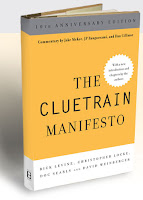
It's been years ago since I read 'The Cluetrain Manifesto' . I think I maybe only read parts of it, back in 2001 or so. After leaving Oce I didn't have a copy of The Cluetrain anymore, so I decided to buy my own copy and read through it from beginnning to end. Now there's a 10th anniversary edition making it even more interesting to do so. Man, what a ride it was. This book is just great. And amazing for the fact they captured what is going on right now so well. This book is a must-read for a social media enthusiasts. But also for all who just started using social media and are trying to understand if this social-thing is a hype or a trend. I'm not going to summarize the book for you. But I wanted to share some nuggets with you. If you haven't read the book, I hope this will trigger you to go and do so. Please let me know if you do! Start here and read through the 95 theses! If you like these and want to know more, read the book . "... everyt...

Being a Member of the 2.0 Adoption Council

Image
This post should have been posted a long time ago... Being part of a big company was great. One of the great things it brought me was being a member of the 2.0 Adoption Council . The 2.0 Adoption Council is a group of Enterprise 2.0 practitioners working for large companies. I was a member of the Council for a couple of years. It was a great source of inspiration for my work. Lots of smart people are in the Council. Actually I was humbled to be part of a group of enterprise 2.0 practitioners that are seen as the leaders in this space. Some had many more years experience than I did. You wonder what they get from the Council? Well, that's one of the great things about these communities: we're all in it to learn and help each other. And that's exactly what happened. Even though some have been in this space for a long time, we're all still just getting started. To cultivate interaction we used Jive, Yammer and Socialcast. And email of course. Even more important were the ...

Where imaginations play, learning happens - A Great Interview

Image
I've always been intrigued by the concept of learning. It's one of the reason I like blogging so much and social media in general. It's a great way to learn! Every now and then I bump into a great post or interview about this topic. Just recently I read a great interview with John Seely Brown and Douglas Thomas about their new book 'A New Culture of Learning' ( part 1 and part 2 ). I was planning to read the book. After reading this interview I'm going to push it up on my to-read list. Thanks Henry Jenkins for sharing this interview with us. I'll share some interesting statements from the interview with you here: One of the key arguments we are making is that the role of educators needs to shift away from being expert in a particular area of knowledge, to becoming expert in the ability to create and shape new learning environments. Our argument brings to the fore the old aphorism "imagination is more important than knowledge." In a networked worl...

Repetitive Interaction Leads to Trust

Image
Some time ago I told you I have a student, Arzu , who's researching enterprise social bookmarking. We'll she's almost finished with her thesis. And I can tell you, I'm really impressed with her work. She's delivered a very fundamental and also practical piece of work. I hope to share more with you from her work in the coming weeks. I'll share a nice quote with you right now. In her final chapters she refers to research done on 'trust' which I find very interesting. Hsu et al. ( 2007 ) explored the effect of trust on knowledge sharing in virtual communities in different stages. They suggest that trust is developed in virtual communities by repetitive interaction of members over time and appears in three stages: economy-based, information-based and identification-based trust. As the relationship develops, the economy-based trust will move to knowledge-based trust, eventually identification-based trust. In the initial stage of participation to virtual co...

Intranet opportunities and challenges in a multi-brand organization #epem

Jenni Laajarinne of Amer Sports Corporation is the first speaker today! 6300 employees. Amer Sports is behind brands as Wilson, Atomic, Salomon and Suunto. Her talk will focus on using social media applications to encourage community-thinking. She has a case example of our organization using and internal social media application to encourage community thinking in the year that marked the company’s 60 th anniversary. They have home-grown CMS, created by IT. They have 6 brand intranet and 4 business area intranets. These intranets are pretty autonomous: the look-and-feel is different, the structure is different, etc. They were looking for a fun and exciting way to celebrate the company’s anniversary. They wanted to take the opportunity to celebrate the employee’s passion for sports. They set up an intranet page to share their sports moments. It ran for 3 months (so it should be simple to use for there is no time for adoption!) and there was a monthly prize. Employees could upload tex...

Social computing and the collaborative intranet #epem

RichardHare , British American Tobacco is the next presenter. They have 60000 employees. Richard is a Knowledge, Communication and Collaboration Consultant. He starts out with the question who loves their intranet? And who’s users love their intranet? Not many hands go up. Complaints about their intranet: Search takes 20 seconds to return meaningless results Content out of date Difficult to navigate when based on hierarchy … but people still want sites. They connected the roll out of the content management tool to the roll out of the new corporate brand. This helped pull things together. (He showed several local intranets. Most looked the same.) Their intranet only has top navigation, no left-hand navigation. Activity updates in the middle, daily news on top. People-centric navigation. Evaluation of the set-up was done with senior management based card sorting and benchmarking. To define if people can find things and understand what the labels are called. Social media at British A...

Overall strategy for employee portal evolution into an enterprise 2.0 platform and integration of effective use of social media for employee engagement and internal communications #epem

Next up is Viviane Dupre of Bombardier. Bnet evolution will be done in a more formal and structured approach. It’s more than intranet; an enterprise 2.0 implementation. They have high level management buyin for the project. A heavily organized governance model. Current version of the Bnet employee portal is from 2004 with less than $100.000 investment. It replaced 100 plus intranets. They have 350 content managers. Minimal governance at the content level. Bnet has been identified as a business critical application. In May 2009 they did a survey. 5000 employees responded to the survey. 64% gave a negative rating of the home page. They also asked what employees actively used on the internet. Like Youtube, LinkedIn. 42% were contributors in 2009. This project was also used to improve employee engagement. By empowering employees, be recognized. Increased employee engagement should lead to increased customer engagement. They wrote up a mission for the Bnet. Stressed enabling and increasing...

Strategic intranet governance and business driven adoption of social media for increasing value @ BT #epem

Wow, that’s a whole mouthful! This is the first presentation at Employee Portal Evolution Masters 2010 in Berlin. I’ll be live-blogging through this conference. The subtitle of the conference is Strategic business approach for employee portal lifecycle management and integration of social media in rapidly changing digital environment’. Another mouth-ful! Mark Morrell , Intranet Manager of BT has the honors of opening this conference. The title of his talk is the title of this blogpost. BT’s intranet is about 16 years old. It started in 1994. It’s available to 140.000+ employees including 3rd parties. All information and applications are online. They can access it wherever they want. They use it for collaboration online too: blogs, wikis, podcasts, RSS, Twitter. Their intranet was also a push towards a more paperless office. They benchmark their intranet through the Intranet Benchmarking Forum. And they’re one of the best… Why did they start using social media? Social media is techno...

Best Practices for Regaining Business Agility #e20s

Image
CheeChin Liew (BASF) is up on the stage. Interesting how CheeChin compares the development cycles in the organization with the development of communication tools. The increasing speed in product development cycles at BASF requires different communication skills and tools. Connect.BASF consists of three pillars: networking. Employees can be visible, profiles, in communities. knowledge sharing. Communities (there is overlap with point 1), tags and search etc. collaboration. Blogs, wiki's etc. It is a global platform. Ho did they start? It started in Communications (by Cordelia Krooß ). They convinced to start a steering committee around this topic (@shake ) with a board member as sponsor. CheeChin was in R&D. He had launched wiki's there. E2.0 was not started by IT. IT came in later. This project is now permanent. In the launch phase they focused on IT implementation a lot. They have connect.BASF days with external, inspiring speakers. They do a lot ...

Leading Like a Shepherd

A nice quote taken from Andrew McAfee's article "Shattering the Myths About Enterprise 2.0" (HBR Nov. 2009): A leader ... is like a shepherd. He stays behind the flock, letting the most nimble go out ahead, whereupon the others follow, not realizing that all along they are being directed from behind.

Not the End of Wikipedia

Image
It's been a while ago I wrote about an interesting piece by Larry Sanger on the Edge blog . That article questioned "the "epistemic egalitarianism" adagium of Wikipedia." In my words: "everybody is equal, an expert is not more (knowledgeable) than a non-expert, together we define what it true." This article by Sanger and my post about it, popped up in my mind when Wikipedia changed its policy so "the unwashed masses will no longer be able to directly edit the profiles of famous living people", as Chris Wilson phrases it on Slate . Of course this move was widely debated. The Slate article gives a nice summary, as does the NY Times . My first thought about this move is nicely stated by Wilson: No matter how you spin this new policy, there's no getting around that it gives more power and control to a small group of people. But if this were a big problem, Wikipedia would have flopped a long time ago. As I've argued before, the encyclope...

Tribalization of Business

Just wanted to point to this very nice interview on the O'Reilly Radar blog with Francois Gossieaux of Beeline Labs . This short (6 min.!)interview gets into all the key issues of communities and organizations ('tribalization of business'). That's really impressive. What I really liked was what Francois said about measuring the success of communities. Andrew McAfee recently wondered if we should introduce 'enterprise 2.0 metrics' . I wasn't sure if this was a good idea and suggested: Can’t we ‘just’ ask for stories and try to quantify them? Ask employees to tell managers how the tools helped them or others become more productive. Francois says the same for communities: the stories about the communities tell you their success. Again, great interview. I'm definitely following the Beeline blog from now on! Tags van Technorati: community , communities of practice , enterprise2.0

7 Key Knowledge Management Principles

What are the key principles for knowledge management? Dave Snowden has been thinking about this topic (a.o.) and kicking against the KM world for some time. Now, he updated his old 3 rules to to 7 principles based on his thinking about KM in the legal profession . They are: 1. Knowledge can only be volunteered, it cannot be conscripted. 2. We only know what we know when we need to know it. 3. In the context of real need few people will withhold their knowledge. 4. Everything is fragmented (also refer to this one ). 5. Tolerated failure imprints learning better than success. 6. The way we know things is not the way we report we know things. 7. We always know more than we can say, and we always say more than we can write down. Great principles to chew on (as Mary Abraham says ). Not only for the legal profession, but for all companies! With respect to 'number 4' I'd also like to point to another great post by Snowden on bottom-up, low-cost knowledge management , starting wit...

The Silo Lives!

Some time ago I posted on an interesting article about "Communication on a Modern, Complex Organization" . Now an interview with the authors has been published . Interesting stuff!

Collaborative Thinking: Communication (and Coordination?) in a Modern, Complex Organization

I needed some time to understand this paper! ‘Collaborative Thinking’ pointed me to it. (Thanks!) The title sounded very interesting and after reading it, understanding most (not all!) of it, I’d like to pass it on to you as recommended reading. The title of this HBS Working Knowledge paper is: “Communication (and coordination?) in a Modern, Complex Organization” by Adam M. Kleinbaum, Toby E. Stuart and Michael L. Tushman. I’ll give you some highlights. First the main question of their research: “The basic question we explore asks, what is the role of observable (to us) boundaries between individuals in structuring communications inside the firm? We measure three general types of boundaries: organizational boundaries (strategic business unit and function memberships), spatial boundaries (office locations and inter-office distances), and social categories (gender, tenure within the firm).” They go into what literature has said about the managerial task: “In these and other theories of...

On Conversations, Connections and Context

Image
John Tropea of Library Clips wrote an interesting, long blog post on " Conversations, Connections and Context ". Go ahead and read it, it's worth your time, if you ask me! John addresses a topic that connect be stressed enough: the concept of context in IT. The stronger the relationship and commonalities you have with a bunch of people, the more you understand each others writings, the more chance their knowledge comes to be your knowledge. You probably agree with this, don't you. But then most of us carry on with our lives. John takes us back to this statement and makes us take a good look at it. Do we really understand the implications of context for instance when we email? Yes, we understand it when we discuss stuff face-to-face. But what happens when we have a conversation via email? Or when we codify 'knowledge'? W.r.t. codifying John says: But the problem here even is that a codified solution is usually formal (stripped of context) eg. when this happens...

Community (and wiki?) archetypes

Take a look at Tara Hunt's blog for an interesting list of community archetypes . She states: This is a very very rough draft of the outline for what the Archetypes look like in a community (mostly thrown up here from TextPad notes). It is important to note that all of these community archetypes play highly positive roles in various communities. In my post on the Wikinomics book , I mentioned that I miss wiki-roles (or archetypes) in the book. Could this list be a good starting point? It looks like it. However w.r.t. wiki's I miss a role in Tara's list. I'd call them: ‘pruners’/'cleaners’. These people that go through wiki pages, don't really add content, but make sure the content is readable. They remove typos, correct layout issues, etc. Is there such a or a comparable role in communities?