Posts

Showing posts with the label internet

My notes from the Internet Trends 2012 Update

I find Mary Meeker's reports on internet trends very interesting. They're packed with interesting data and insights. I've been following her work closely. She recently published an updated overview of 2012 and I thought I'd share my highlights with you at the end of this year. sheet 9: stunning slide showing shipment of iPads, iPhones and iPods over 10 years compared. This slides is old(er), but it just underlines the interesting times we live in sheet 10: You thought the ramp up of Apple products is huge, well Android ramp up is 6 times that of iPhone sheet 12: 30% of US adults own a tablet, less than 3 years ago that was 3% sheet 17: mobile advertising is growing rapidly; $0.7 billion in 2008, $19 billion in 2012 sheet 18: 24% of online shopping was done via tablets on Black Saturday, versus 6% 2 years ago sheet 20: we are in the midst of a huge change powered by new devices + connectivity + UI + beauty . Meeker highlights the effects for the pc, photography, ...

Is our web slipping away?

Image
Sometimes I read a post that really gets me thinking. Anil Dashes' recent post 'The web we lost' did it this time. I think reading the full post is well worth your time if you're interested in where the web is headed. Two fragments from the post triggered me the most: We've lost key features that we used to rely on, and worse, we've abandoned core values that used to be fundamental to the web world. To the credit of today's social networks, they've brought in hundreds of millions of new participants to these networks, and they've certainly made a small number of people rich. But they haven't shown the web itself the respect and care it deserves, as a medium which has enabled them to succeed. And they've now narrowed the possibilites of the web for an entire generation of users who don't realize how much more innovative and meaningful their experience could be. (...)  The first step to disabusing them of this notion is for the p...

Less Filter Bubbles with Twitter and RSS?

Image
Talking to an old-aged man who had just discovered the internet, he said: "The internet is just so great, what a huge amount of sources we have there!" And I agree with him. The internet is amazing. The huge amount of content shared there about all kinds of topics. The way we can interact with content and people via the internet. The amazing number of different internet services. And we have reached the end of what the internet will bring us. But is the internet all good. There have been many that question if the internet is such a positive force. Shouldn't we question some (or all) of the changes the internet is doing to the world and to. Andrew Keen wrote about the negative aspects of the internet on culture . Nicolas Carr published about book about what the internet is doing to our brain . And more can be mentioned here. Recently I bumped into a review of The Filter Bubble in my Dutch newspaper , went over to watch the related TED Talk with the same title and ...

Internet Trends 2011 and on

Image
There is one presentation I love watching every year. It's loaded with data and just sets the agenda for the coming year. It's Mary Meeker's talk at the Web 2.0 Summit . You can watch it here:  And find the slides here . As I said, it loaded with data and insights. I'll highlight just a few. Striking is the international growth of the internet. It's definitely not the US-only in the internet. And Africa and South-America are continents to pay attention to. Another thing is the speed of adoption of new communication technology is increasing, even in recession. The speed of adoption of the iPhone was fast compared to the iPod, but just look at how quickly the iPad took over the market. The next big thing according to Meeker? Everything that has to do with our ears; Sound/audio. And, of course, the continuing growth of mobile.

Will Everything be Free? – My Review of Free

Image
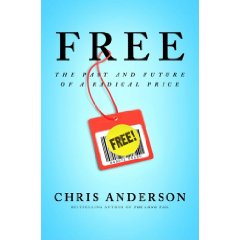
So, I’m on a roll now. As promised I would share my review of several books. This is the next one: Free by Chris Anderson. An article in Wired about Free triggered me to read this book. Free is a big deal nowadays. Many products and services are offered for free. And people are making lots of money charging nothing. “Not nothing for everything, but nothing for enough…” (p. 3) Free has always been around a long time, but it’s changing. The internet seems to be doing something interesting to what we pay for things. “Somewhere in the transition from atoms to bits, a phenomenon that we thought we understood was transformed. “Free” became Free.” (p. 4) This book is about this phenomenon. Chapter 1-3 dive into the fascinating history of free. And the different kinds of free: direct cross-subsidies, three-party market, freemium and nonmonetary markets. (p. 23) Free started out as a marketing method. Now free is an entirely new economic model. (p. 12) The old free was based on the econ...

Macrowikinomics, Rebooting Business and the World - My Review

Image
A while back I read Wikinomics , by Don Tapscott and Anthony Williams. I really enjoyed it. So when they published a new book, Macrowikinomics. Rebooting Business and the World , I was curious, bought and read it. The book Wikinomics was about the power of mass collaboration for business. But this new model of collaboration goes beyond a business or technology trend. It's a "more encompassing societal shift". So, this new book wants to show how wikinomics and its core principles can be applied to society and all of its institutions. Principles What are the wikinomics principles? The 6 principles summarized for you with a quote. Collaboration - "... the collective knowledge, capability, and resources embodied within broad horizontal networks of participants can accomplish much more than one organization or one individual can acting alone. Of course, hierarchies won't disappear from the economy in the foreseeable future. Nor are we likely to see large top-...

My Cluetrain Manifesto Notes

Image
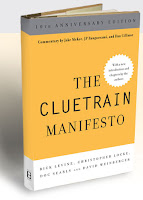
It's been years ago since I read 'The Cluetrain Manifesto' . I think I maybe only read parts of it, back in 2001 or so. After leaving Oce I didn't have a copy of The Cluetrain anymore, so I decided to buy my own copy and read through it from beginnning to end. Now there's a 10th anniversary edition making it even more interesting to do so. Man, what a ride it was. This book is just great. And amazing for the fact they captured what is going on right now so well. This book is a must-read for a social media enthusiasts. But also for all who just started using social media and are trying to understand if this social-thing is a hype or a trend. I'm not going to summarize the book for you. But I wanted to share some nuggets with you. If you haven't read the book, I hope this will trigger you to go and do so. Please let me know if you do! Start here and read through the 95 theses! If you like these and want to know more, read the book . "... everyt...

The Information: What is the Internet doing to us?

Something great to read for the weekend (- you'll need some time to read it -) if you're interested in the web and what the effect of the web is on the way we live and think. This great pieces triggered me because I ran into an interview about a new book, 'The Information' . I thought this article was also about it, but it is and it isn't. This article is about the thesis that the internet is changing the way we think and our brain itself. Or isn't it? Well, find out by reading the article. Highly recommended! Great food-for-thought and input for lengthy discussion. Thoughts are bigger than the things that deliver them. Our contraptions may shape our consciousness, but it is our consciousness that makes our credos, and we mostly live by those.

Business challenges in migrating a large intranet to an employee portal at Nestle #epem

Helen McCarthy, eCommunications Manager at Nestle. Nestle is a huge organization. 280000 employees at Nestle (100000 in factory), 449 factories, operations in 83 countries. Nestle runs their old portal on SAP. Of course they also have email, fileshares, etc. What they needed was collaboration, up-to-date content, reduced information overload, transactions/workflows, global vs local communications, ability to target, confidentiality/security. They set up a new portal based on SAP. One landing page, showing relevant information to the employee. But the employee couldn’t decide if he/she wanted something else targeted to him/her. The targeting was too restrictive. The technology was as well. So, they had a Kit-Kat break! ;-) They now want to model their intranet around their internet site. Their internet works and won awards. It was built on Sharepoint and so the intranet will be as well. They're aiming for the iPad as the standard of usability. Nestle's intranet will have the em...

Scoren met Social Media [Dutch]

Image
Er wordt veel gepraat en gesproken over social media. Maar wat is social media? Of is het: wat zijn social media? Waarom zou ik dit moeten weten en wat kan ik ermee in mijn dagelijkse praktijk? En als ik het zelf gebruik, is het misschien ook mogelijk om het zakelijk te gebruiken? Hoe zou het bedrijf waar ik voor werk social media kunnen inzetten? Om deze vragen te beantwoorden heeft het bedrijf Entopic Internet expert Erwin Boogert gevraagd om een boek te schrijven. Onlangs is het boek verschenen en het heeft als titel 'Scoren met social media'. Het is te bestellen via Entopic of boekhandel. Boogert is er goed in geslaagd om er een leesbaar en leerzaam boek van te maken. Leerzaam, ook qua praktische spits. Het boek wil de lezer echt aan het werk zetten, persoonlijk en zakelijk. De lezer wordt hierdoor aangespoord door alle praktijk cases die verwerkt zijn in het boek en het gedeelte van het boek wat wil helpen om te komen tot een social media strategie. Het boek is op...

Welcoming a New Blog on Communications

I love pointing to new good blogs! Regularly friends and colleagues start a new blog. My friend and colleagues Jan van Veen just made the leap. He started his blog called 'Corporate Internal Communications' . Jan is an expert in (internal) Communications. He's also very interested in what the Internet, especially social media, is doing to Communications inside and outside companies. Jan and I have been collaborating heavily in this area. I hope you all go over to his blog and subscribe to it. Leave a comment to welcome him to the blogosphere! His first post is about the end of the intranet . His second is about how simple publishing on the web has gotten . Good to have you in this space, Jan. Go for it!

Moved by the Mobile Web

Image
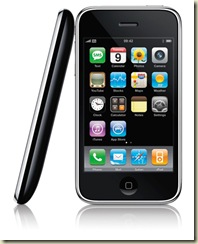
For some time now I've been following the mobile web with fascination. How quickly this market has grown and is still growing! I can remember getting my first (Prepaid!) mobile phone about 9 years ago. Even then a mobile phone was something not everyone had. Some people were even very irritated by "all the people calling in public (on the street) and sitting in the train". I don't hear that complaint very often anymore... Then slowly but steadily the mobile web popped up. Actually it was already there but just way too expensive for mainstream use. I don't think the mobile web is mainstream now, but it definitely is getting there. Recently I bought an iPhone 3GS (I know I'm slow...) and now have my own real experiences with it. And I must say I was impressed without having a smartphone. But I'm even more surprised and fascinated by it now. Like with many technologies, after you start using it, you really feel it. You suddenly actually experience the ...

The State of the Internet Operating System by Tim O'Reilly

This is why I love the blogosphere! And it proves the blogging is not (just) for dummies and show-offs. There's some real deep thinking and interesting interaction going on on blogs. Need proof? Read this post by Tim O'Reilly about 'The State of the Internet Operating System' . What a great piece! It gives a very interesting and inspiring overview of what the Internet is now and what it can do. Here are some highlights if you're still nog interested in reading it all: Ask yourself for a moment, what is the operating system of a Google or Bing search? What is the operating system of a mobile phone call? What is the operating system of maps and directions on your phone? What is the operating system of a tweet? Interesting questions, eh?! O'Reilly goes on to take a look at the competing Internet Operating Systems or The Information Operating System. An Information Operating System because: The underlying services accessed by applications today are not ...

Rupture - Are You Ready for the 21st century?

Nice video by Michel Cartier titled "Are you ready for the 21st century?" (Found via Luis Suarez on his blog - thx!) Are You Ready for the 21st Century ? from Michel Cartier on Vimeo .

From Atoms to Bits and Back

Oof, really have to get back to blogging... I've been very busy with a product creation process re-engineering project. In general terms it's business process re-engineering. Recently the business team release their process descriptions, way of working descriptions and requirements to manage the processes. I'm in the Architecture Team, but also one of the Functional Team members. So now it was our turn to take the requirements and flip them into a functional specification. Interesting but cumbersome work... As I tweeted I'm also reading Chris Anderson's book 'Free'. And I'm really enjoying it! One of the interesting remarks he makes is: every that goes from atoms to bit will be 'free'. But Chris Anderson doesn't stop thinking. In the last Wired issues he says the following. Very interesting stuff! "Peer production, open source, crowdsourcing, user-generated content — all these digital trends have begun to play out in the world of atoms,...

Finding Information: thoughts on an IDEA study

Michael Douma of IDEA , which stands for the Institute for Dynamic Educational Advancement, contacted me a couple of days ago. IDEA is "a nonprofit organization working to improve the ways people interact with technology, conducted a study using three complementary surveys to determine how people find information online and how the experience of web site visitors can be improved." He sent me an email with a pointer to his/their new study. It’s titled, "Finding Information. Factors that improve online experiences" . This sounded interesting, so I went on to read the whole study (17 pages) and think about it. The study is based on an extensive survey, which was held under different users (web designers, nonprofit organizations and general public). The introduction says: "The survey questions were designed to answer the following questions: - What makes a web site effective? - What factors contribute to visitors’ enjoyment of a web site? Does this vary by segments...

The End of Theory?!

Wired has a thought-provoking and interesting article by Chris Anderson, titled "The End of Theory: The Data Deluge Makes the Scientific Method Obsolete" . This article has spurred a lot of discussion on the internet. I'm still thinking it over. But I'll put my two cents in: I wonder if Anderson's take is true for all of science. If so, everything is data and can be described by data. I know that lots of people think this is true (e.g. singularity theory). However I think reality can not only be described by data. For instance, can someones soul be described by data? And, doesn't Anderson's article itself show we always (or often?) need theory (hypothesis, believe, convictions) to say something about practice? Anyway, large parts of reality can be described by data. And for this Anderson's theory is very interesting indeed, just ponder on the examples that he gives. Some highlights from the article: About the Petabyte Age: "It forces us to view...

Download World-Record for Firefox!

Image
Thanks for the certificate. But first of all: thank you Mozilla for building a wonderful browser! Keep up the good work.

Is Filtering the Next Step for Social Media?

Image
As you know I'm a big fan of the ReadWriteWeb blog . They have a wonderful writers panel and cram out insightful posts regularly. Not too long ago a post was written about the next step in social media. It is titled: 'Why Filtering is the Next Step for Social Media' . The beginning of the post was hard to follow, to be honest. But I like the line of thought and agree with the last section: Filters are rapidly becoming a pertinent issue for developers of social media services. As a result, social aggregation platforms are in the perfect position to lead the pack. While this is no easy task and one that cannot be solved in its entirety, it would help resolve another issue social media users are facing: courtesy. Instead of being able to freely add whatever service you wish, some users like myself are taking into account what others may consider noise on certain services as a courtesy to members. In essence, you are becoming our own filter. You may refrain from important ot...

Is Life Speeding Up or Slowing Down?

Will life slow down in the future or will it continue to speed up? Interesting post on the ever-increasing speed of life by Alex Iskold on ReadWriteWeb . It titled: "Faster - Why Constant Stress is Part of Our Future" .