Posts

Showing posts with the label social networks

A World without Email by @elsua #intra13

Image
We started out the workshop with sharing who we are and how we cope with email. Surprisingly most says they cope with email quite well and don't experience email as a huge issue. But all would like to use email in a better way and get others to do so as well. All participants have some kind of collaboration tool inside their firewall (not saying it's used well or not). Luis Suarez finds many high-level manager balk when they hear the word 'social', so he uses 'open' more. He stresses that email is a great way to share information. Which is true, says Luis. But you must add: in a silo. And his 'war' on email is not about killing email but repurposing it. Luis asks why colleagues of the partipants are reluctant to use (internal) social/open tools: time no big value loss of control relevance of information convenience availability security resources governance no fame what's in it for me? over-sharing extra tool not business critica...

Do you have more than 150 friends?

Image
Do you know more than 150 people? You probably don't. And do you have more than 150 friends on Facebook and followers on Twitter? You probably do. But are they really your friend? Do you really know all 150 of them? I don't think so. A long time ago I ran into Robert Dunbar's research on social networks. I wrote several posts about Dunbar's number and have been collecting interesting links as well. Just recently Dunbar was interviewed   by Technology Review about his number and social networks. What is Dunbar's number about? His research basically showed... ...that humans have the cognitive capacity to maintain about 150 stable social relationships.  The first time I read this I thought: What?! But it's is now my experience this is true. Even for social media friends and followers. I follow way more that 150 people, but I know and truly engage with 150-300 of them. Of course Technology Review was also wondering if Dunbar himself still thinks his...

Is email dead? Or is it moving to social networks?

Image
Is email here to stay or will it die? Will it die because social media is here or will something else replace email? Recently Steve Dale wrote an interesting post about this topic. It's titled 'Email is dead: long live email!' . It was discussed on G+ and the blogpost itself has many interesting comments. I thought I'd share my comments here as well. Please read Steve's post first. I think it's an important post for social business people. Steve lists several reasons to use (and keep on using) email: Email arrives near instantaneously. It can be accessed from almost anywhere. It brings not just text, but pictures, documents, links, and more. Email is great for non-urgent communication. Things that don’t require an immediate response that others can deal with on their schedule. Email can provide a powerful documentation trail. Unlike text messages or phone calls, email provides an authenticated audit trail of past communication. It is hard to deny pas...

From trees to networks

Image
Just before the weekend I wanted to share this interesting 10 minute talk with you about hierarchies and networks. For one because it's just fascinating to watch how RSA visualizes this talk. Secondly because of the talk itself. Manual Lima's talk about "The power of networks" is fascinating. He gives an overview of how we used to try to structure everything in hierarchies and trees, because we like order and simplicity. And how we now shift to using networks more because trees simply can't describe reality. Knowledge, species, bacteria, our brain, our body, societies, etc. are highly connected. He wraps up his talk by asking if there is a universal structure? Well, do you think there is one? Of course there has been lots of thinking and talking about what this means for organizations, people and technology. The shift Lima describes is the shift 'social business' and 'enterprise 2.0' is describing. And it's the shift social technology is...

Social technologies are extending organizations

Image
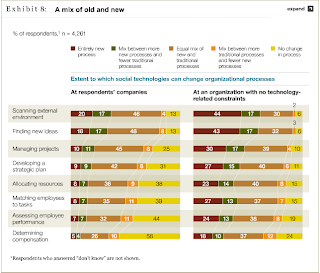
McKinsey has been following the social business movement for some time now. And they're following to see if it can live up to the expectations. Recently they published the results of their 5th annual survey under 4200 global executives. The polled them how their organizations use social tools. The finding of the report are interesting. There's clear progress: social tools are being used more and more and in more effective ways. When adopted across the networked enterprise and integrated in work processes of employees, clear benefits are seen. There's a boost in financial performance and market share, which relates to the results of previous surveys. However not many companies are fully networked, meaning they are internally and externally networked. One of the most interesting things I read in the report was the fact that executives believe if organizational barriers to social tools diminish, they could transform the core business processes. This is a big stateme...

Linking Strategies in LinkedIn

Image
How do you use LinkedIn ? Who do you connect to? Do you use LinkedIn Groups? This post on the NextWeb triggered me to answer these questions publicly. Resume LinkedIn is an interesting platform. I've been using it for several years now. At first I basically uploaded my resume to LinkedIn. I hardly visited LinkedIn after that, except for excepting link requests. Some time after that LinkedIn introduced Answers . I followed several topics there, but stopped after about a year. The quality of the questions was horrible and it seemed I didn't get anything back from the answers I gave. Groups I also joined several LinkedIn Groups. Groups is interesting and it keeps me coming back to the LinkedIn site. Right now I'm following 27 groups, mostly in my area of expertise (intranet, social media, knowledge management, enterprise 2.0, social business). Most of the groups have interesting discussions. The update in my email every day helps me keep up with what's going on i...

Understanding Social Media Concepts

This is a really good post: It’s Not Twitter or Facebook, It’s the Power of the Network ! In workshops that I give about social media I always try to stress the fact that the underlying concepts of social media are more important to understand than the (popular) tools like Twitter. The tools will come-and-go, but the underlying concepts are here to stay, in my opinion. And they'll continue to evolve as well. The above-mentioned post underlines this as well, responding to the claims that Twitter etc have caused the turmoil in Tunesia, Egypt, etc. Some quotes from the post: The real trigger for the uprisings, they argue, is simply the frustration of the oppressed Egyptian people — which is undoubtedly true. But it also seems clear that social media has played a key role in getting the word out, and in helping organizers plan their protests. In the end, it’s not about Twitter or Facebook: it’s about the power of real-time networked communication. (...) But is anyone really arguing tha...

Thoughts about Quora

Of course you've heard of Quora . Lots of posts have been written about Quora.  I've been using it for some time now . I'm not a heavy user; I dip into it every now and then. I think it's interesting. It taps into the power of asking questions . I am surprised though that Quora took off so quickly. Is the world really waiting for a new and separate platform specifically designed to ask and answer questions? For now it seems the world is. For the long-term I don't think Quora will stay around in this form. As I tweeted I think Quora will be acquired by and integrated into Twitter (like in Yammer ). Or Twitter will add Questions functionality (like Yammer). Why? Because knowledge workers are extremely efficient. They don't want to have the tools spread out everywhere and have to look into all those tools one by one. Furthermore, we could already ask each other questions on Twitter. Tweeps would just mark these tweets with a hashtag like #question, #justasking o...

Connected Professionals - Novay

Image
There's lots of buzz about 'The Future of Work'. And quite a bit is focused on technology. I don't think that's very strange. Most technology is specific, it's concrete. You can talk about how it works, which features it has, etc. The Future of Work is about more than tools. It's also about facilities (building, furniture, colors, etc) and most importantly about organization (structure, processes and networks, culture, behavior, etc). In my opinion one of the groups with the most fundamental research on this topic is Novay , specifically the Future Workspaces or ProWork group. And they ground there research in practice. Their approach is interesting because it's broad, focusing on organizational and technology issues (not facilities). They've publish about their work regularly on their blog. One of their interesting reports is titled "Connected Professionals. Flexible working in a networked society" . It shows their way of working: deep ...

A history of Social Networks - Open always wins

Image
Techcrunch ran a very interesting series of posts about the history of social networking . They were written by Mark Suster ( @msuster ). I think you should go ahead and read all the posts, but I'll pass on some highlights here to get you started. Marks posts are about the “6 C’s of Social Networking” – Communications, connectedness, common experiences, content, commerce & cool experiences (fun!). He stresses that social networks exists before they were hyped in our time they just work better now "and there are more people doin’ it." And a bit further on: "Yes, social networks of 2010 have much better usability, have better developed 3rd-party platforms and many more people are connected.  But let’s be honest – they’re mostly the same old shit, reinvented, with more people online and trained. But less considered is the fact that the success of the Web 2.0 companies versus the Web 1.0 ones were enhanced because they coincided with hardware that allowed us to c...

Launch of a merged intranet and first steps to an integrated social media platform #epem

Johan Hillebrand, Head of Internal Communication at ABN/Amro. Two main challenges Communications has: information overload (too much email…) and they couldn’t find information. Another thing that was mentioned was: stop paper communication, move to digital. They decided to take on these challenges by building a new intranet. Goals for the new intranet: Fewer channels Offer relevant information Centralize content They choose to have the intranet look a lot like their internet site. No complaints about confusing the intranet for the internet yet. (They launched a couple of weeks ago.) They kept the look and feel very simple. They combine general and local news. They assume people have 10 minutes to read news and cluster that in a box. ABN has a separate social media platform (not integrated in the intranet). It's called Arena. It was built by one of their contractors. They plan to integrate it into the intranet in the future. But the look-and-feel is the same. They piloted withi...

Establishing social software to drive expertise exchange and how to measure it #epem

Wolfgang Jastrowski of Swiss Re is up next. They use Jive for their intranet platform (out-of-the-box). The interesting fact is that they don’t train users. Wolfgang is from IT. They provided the platform and have users decide how to use it. Blogging has not taken off as well as they thought. So they created roundtable to increase blogging. How did they introduce social media tools inside? In 2008 the company realized that collaboration is key. They wanted a community centric collaboration approach. Objectives: Better support virtual teamwork Boost information sharing across functions Accelerate agility and responsiveness Advance innovation and solution creation Etc. In short: they wanted a platform that would support their cultural change. They went live with Jive in Q3 of 2009. They then already had 1500 users. At the end of 2009 they had 10000 users. Their key lessons: Strive for long-term objectives but work in phases and take the time needed Position it as an integrated b...

A Holistic Approach to Enabling the Collaborative Enterprise #e20s

Image
Lee Bryant closed the Enterprise 2.0 Summit with a talk about Social Business. Where's Enterprise 2.0 headed next? It's in the direction of providing real business value. Enterprise 2.0 has been adopted at least a bit by most organizations. There's a nice spread of use cases, showed by research supported by Headshift . Lee sees Enterprise 2.0 as a Trojan mice for organizational change. Small but impressive changes to the organization. Enterprise 2.0 is still in the early phase, patchy and tool-centric (like the KM wave was in the beginning). We're looking for quantifiable business improvements, like: lower operational costs networked productivity business agility effective management (move away from information hostages: businesses run by writing and moving report up and down the ladder) customer centricity (Listen! But many companies lack a structure to socialize what you're learned by listening) Where is business practice going...

Best Practices for Regaining Business Agility #e20s

Image
CheeChin Liew (BASF) is up on the stage. Interesting how CheeChin compares the development cycles in the organization with the development of communication tools. The increasing speed in product development cycles at BASF requires different communication skills and tools. Connect.BASF consists of three pillars: networking. Employees can be visible, profiles, in communities. knowledge sharing. Communities (there is overlap with point 1), tags and search etc. collaboration. Blogs, wiki's etc. It is a global platform. Ho did they start? It started in Communications (by Cordelia Krooß ). They convinced to start a steering committee around this topic (@shake ) with a board member as sponsor. CheeChin was in R&D. He had launched wiki's there. E2.0 was not started by IT. IT came in later. This project is now permanent. In the launch phase they focused on IT implementation a lot. They have connect.BASF days with external, inspiring speakers. They do a lot ...

Enterprise 2.0 The Book by @amcafee, A Review

Image
Some time ago I said: Vacation First . I wanted to share my review of professor Andrew McAfee's book Enterprise 2.0 before I went on vacation. That didn't work out. I wish I could have written this review sooner, because the sooner you read this book the better. I'll tell you why. Andrew McAfee coined the term 'enterprise 2.0' (in 2006) and has been one of the leading thinkers in the space of applying web 2.0 concepts and tools (or 'collaborative media' as McAfee likes to call them) to the workplace. This book summarizes his thinking over the years. Of course he's been blogging and speaking about this topic. So I was wondering if this book would bring me new insights. Well it did. And to me this is why I love books. You know thinking about the topic you're reading about in a book won't stop as soon as the book has been published. But a book does give you a summary of past thinking and concepts for future thinking. And all that in a limited...

Use Social Media to Understand Them

Absolutely great post by Chris Dixon about experiencing social media . Just go ahead and read it. It's short, but good. This is exactly the reason I like to tell people about what I get from social media, but stopped to push them into this space. They have to do that on their own. Experience them. Give them some time. And dismiss them then if you like.

Scoren met Social Media [Dutch]

Image
Er wordt veel gepraat en gesproken over social media. Maar wat is social media? Of is het: wat zijn social media? Waarom zou ik dit moeten weten en wat kan ik ermee in mijn dagelijkse praktijk? En als ik het zelf gebruik, is het misschien ook mogelijk om het zakelijk te gebruiken? Hoe zou het bedrijf waar ik voor werk social media kunnen inzetten? Om deze vragen te beantwoorden heeft het bedrijf Entopic Internet expert Erwin Boogert gevraagd om een boek te schrijven. Onlangs is het boek verschenen en het heeft als titel 'Scoren met social media'. Het is te bestellen via Entopic of boekhandel. Boogert is er goed in geslaagd om er een leesbaar en leerzaam boek van te maken. Leerzaam, ook qua praktische spits. Het boek wil de lezer echt aan het werk zetten, persoonlijk en zakelijk. De lezer wordt hierdoor aangespoord door alle praktijk cases die verwerkt zijn in het boek en het gedeelte van het boek wat wil helpen om te komen tot een social media strategie. Het boek is op...

Relating structured and unstructured knowledge processes - KMers chat #kmers

Just a small post to invite you all to join the next KMers Chat on this Tuesday, October 5 from 17:00 - 18:00 UTC. I'll be moderating this chat. Participating is easy. All you need is a Twitter account. Just wait for the chat to begin and make sure to append your tweets with #kmers . Lots of interesting and smart people join in . This chat will be about: Relating structured and unstructured knowledge processes . Here's a short overview of this topic and some questions: Knowledge Management is currently often related to the unstructured information and knowledge processes in organizations. In the past the focus of KM was on the structured side. But how can/are these combined in organizations? More specifically: how does enterprise 2.0 relate to BPM? (As you may know this is being heavily debated now on the web.) Questions: Intro: Is the summary clear? Is the distinction clear? What do you call unstructured information/knowledge processes and structured pro...

The Problem with (Enterprise) Social Bookmarking?

Image
The Dachis Group recently shared a really nice overview of "The 2010 Social Business Landscape" , written by Dion Hinchcliffe . One of the tools I missed in his overview is 'social tagging' or 'social bookmarking'. Based the research being done by my student , Arzu Yucekaya , on social bookmarking, I've thinking about and discussing with her why social bookmarking adoption seems to be harder than, for instance, the adoption of enterprise microblogging. At least, in the company I work for... I'd like to share a citation from a (preliminary) version of her literature research. This citation relates to the adoption of knowledge sharing tools in organizations in general. She writes: In the context of knowledge sharing systems, public good nature of knowledge introduces two major challenges that organization face (Prasarnphanich & Wagner, 2008): 1. The start-up problems (achieving critical mass) 2. Discontinuity problem (sustainability...

Focus on Social Media Philosophy

Luis Suarez , one of IBM's well-known social media evangelists and email killer, has a really nice post titled "Forget social strategy, think social philosophy: Hippie 2.0 ". I hope you go ahead and read it. I'd love to hear your thoughts about his post (by leaving your comments on Luis' blog). I'll insert my thoughts here (that don't only apply to social media, by the way): Nice post, Luis! I agree talking about the underlying philosophy and/or concepts of social media is insightful and helpful. I find talking in this way to employees and managers helps. As an IT manager in the company I work for said: "When deciding to do an IT investment let's not talk about money/ROI first, but first make a decision based on the story." In your terms: The philosophy should make sense and be understood first.