Posts

Showing posts with the label information

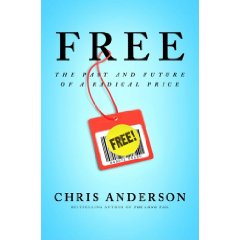
Will Everything be Free? – My Review of Free
Image
So, I’m on a roll now. As promised I would share my review of several books. This is the next one: Free by Chris Anderson. An article in Wired about Free triggered me to read this book. Free is a big deal nowadays. Many products and services are offered for free. And people are making lots of money charging nothing. “Not nothing for everything, but nothing for enough…” (p. 3) Free has always been around a long time, but it’s changing. The internet seems to be doing something interesting to what we pay for things. “Somewhere in the transition from atoms to bits, a phenomenon that we thought we understood was transformed. “Free” became Free.” (p. 4) This book is about this phenomenon. Chapter 1-3 dive into the fascinating history of free. And the different kinds of free: direct cross-subsidies, three-party market, freemium and nonmonetary markets. (p. 23) Free started out as a marketing method. Now free is an entirely new economic model. (p. 12) The old free was based on the econ...

Enough Information

Image
When do you have enough information to make a next step or a decision? As you may know I love to process lots of information. Depending on the type of information I'll dive into it deeply or just dip my toe in it. After processing lots of information deciding when enough is enough has become easier for me. But it's hard for me to describe when I stop taking in information. Dave Snowden's Cynefin model has helped me in this sense. (By the way Snowden is currently summarizing the Cynefin model/approach/concept in several posts . The Cynefin model basically says: look at cause and effect. Is the cause and/or effect clear? Is the relationship between both clear? Depending on your answer different 'next steps' should be taken. For instance if the relationship between cause and effect is completely unclear. This is the complex domain. Probing is the thing to do. Don't go a read volumes of books and articles. Probe and see what happens, then act, etc. Even though ...

Requirements for Document Management Systems

Recently I was honored to co-write a paper with Olha Bondarenko and Ruud Janssen . It is titled: ''Requirements for the Design of a Personal Document-Management System" and was published in JASIST . I think Olha's work in general and this paper in particular is very valuable for the whole information, content and document management industry.  Because it truly tries to understand how knowledge workers use information and documents. That knowledge is translated into requirements/principles for a document management system. But you decide if Olha/we succeeded! I hope you like it. This paper was written in the context of Olha's PhD research - which was finalized recently! - about personal information management. Her PhD defense will be on February 11 (at the Technical University in Eindhoven, The Netherlands). I hope to be there and will blog/tweet about it. Tags van Technorati: information management , knowledge management , document management

Too Much Communication

Image
Last weekend I read an intriguing article in the Dutch newspaper, NRC . A communication researcher, Tjardus van Citters , wanted to give us all well-meaning advice. (Dutch titel: 'Welgemeend advies van een communicatie-expert: minder communicatie, s.v.p', Sept. 20, 2009.) His article gives an overview of the sources that are increasing the number of signals we process each day. For instance the number of communication providers has increased. And the fact that our senses are being addressed more than ever. This overview leads to his advice to communicate less. Why? Because our health is at stake. Our brains get more impulses to process. The model of 'selective perception' is out-dated. We get irritated by communication we did not want to see, leading to restlessness, even illness. He therefore advises us to turn off signals. Read the news once a week instead of every few hours. Unsubscribe to things you don't want to receive. Be clear what kind of emails you ...

Re: When Information is Not the Answer

Image
Andrew McAfee has another really nice post: 'When Information is NOT the Answer' . I advise you to go and read it, definitely if you are in IT. And for Knowledge and Information Management experts this post summarizes what you've been trying to tell IT all along. McAfee basically shows that not all information can be processed using IT systems. Even though many think so and heavily depend on these systems for decision making. And he gives an example of a company, Zara, that acknowledges this and works with it in practice. In a comment on his post I pointed to two books that underline the point McAfee's making. One is 'Blink' by Gladwell. (And I'll write a review of this book soon.) And the other is 'The Social Life of Information' by Seely Brown & Duguid. (The last book is one of my all time favorites.) If you haven't read them, please do so. It's very worth your time. In 'The social life' they have that nice example of a c...

Different types of content

Mark Morrell of BT has an interesting post on the different types of intranet content they distinguish . I commented on this post , but would like to extend my comment here. Mark distinguishes between personal, crowd, team and formal content. I commented: Interesting post! What I was wondering is: is this list right? For you I understand it is. But can’t ‘team’ content be ‘formal’ for instance? And isn’t ‘personal’ a security issue? For instance, I’m working on some content I don’t want to share yet (so it’s personal), but in time it will be in the category ‘crowd’? I’ll blog about this and tell you what my categories are. Thanks for sparking this discussion. I'm curious if you agree with my remarks. Do you make different distinctions? Anyway, I think it's great BT is distinguishing between content. I find that lots of content that is now on intranets shouldn't be their anyway. And I see that BT is not only making this distinction but also providing different ap...

Where's Information Headed?

Image
Thomas Baekdal has a very interesting post titled "Where is everybody?" His post comes along with a really nice visualization to prove his point (refer to his blog post and the picture I added into this post). It would be interesting to extend this post and visualization with other kinds of information. For instance, office documents, flyers, etc. Baekdal also leaves out books. Books would come in between 'local marketplace' and 'newspapers', I think. And office documents (like Word docs) came around 1990-1995? I remember typing my first report in WordPerfect around 1993. At that time you were still allowed to write your report in handwriting. Wow, time flies! --- If You Read This and Like It, Tweet This to your Followers: Where's Information Headed? http://twurl.nl/56qrqe Tags van Technorati: information , information management , information architecture

Why Read Blogs at Work?

Nice post on why you should read blogs at work . Actually I was quite surprised we need a post on this topic. I would say: of course you read blogs (and other information) at work! Apparently some people need to be convinced... And I hope they are after reading this post.

Paper documents more secure than digital ones?

Interesting pointer to an article about the security of paper and digital documents . Are digital documents more secure than digital ones? Some time ago Xerox demonstrated ink that would fade from the paper after a certain period of time.

The First International Conference on Information Management

Image
How could I have missed this?! I thought I had all my information flows well organized... Next week Friday, the 23rd of November, the First International Conference on Information Management will be held in Amsterdam ! They have an absolutely wonderful program with great speakers . The conference theme is 'Business Information Management. Is information management in need of a new identity?' . If you are going, please let me know. I'd like to get a copy of your notes/blog posts. An interesting fact for Océ (the company I work for) is the documentary that will presented to the public. It's titled: The CIO as strategic partner . And our CIO Peter Hagedoorn figures in this documentary. You can get a sneak preview here .

Google Tech Talk by Alex Wright

Image
Just started reading Alex Wright's book, Glut. Mastering Information through the Ages . It's really interesting and gives a wonderful overview of the history of 'information management'. Alex also just gave a Google Tech Talk on his book . It's not a substitute for the book, but it's worth your time anyway. Interesting fact: Xerox PARC coined the term "information architecture". (35:00) There mission was: "The Architecture of Information".

Inbox Zero: Merlin Mann's Google Tech Talk

Merlin Mann, from 43 folders , gave an interesting Google Tech Talk titled "Inbox Zero" . Merlin asked to share the video with you. Here you are! I'll give a (short) summary of the talk, but please block an hour and sit back, learn and apply. It worked for me, although most of it can also be read in David Allen's, "Getting things done" (GTD) - which is very worth the read. I apply it to my daily work and it helped me be more productive. Here goes the summary: Email was like a little hug I (Merlin) was giving people a hug and getting hugs from people. But it didn’t always stay that way. Email became the one source for all incoming and outgoing information. You didn’t need a system to handle email. Now you do. A simple and complete framework how to deal with your email. More and more people live in their email. They do everything in there (for practical purposes). They have their system in there. That is not a way to live, according to Mann. You should ...

Keen-Weinberger debate

There's been some buzz on the debate between Andrew Keen and David Weinberger at the Supernova conference and in the WSJ . It's an interesting and weird discussion in many ways. At Supernova Weinberger gives an interesting overview of handling analogue and digital information. Ending up in "digitalizing everything" and having users organize it. I find it disappointing that he didn't go into the fact(?) that not everything will be digitalized. Remember "The myth of the paperless office"? We live in a mixed world, with paper and digital information, with structured and unstructured information. The real question is: how do we cope with that, how do we organize this way of living, can it be done? Furthermore, I simply can't seem to understand the point Keen is making. Every time Keen says/writes something I came up with an answer (except for the points that Weinberger agrees with such as "authority on the web"). And, funny enough, Weinbe...

The history of information

Image
This is old (why didn't I find this years ago?!), but but none the less interesting. David Weinberger wrote about it recently on his blog . In 2005 Arjan Vreeken wrote an interesting historical overview on the concept of information . It's a well-written and concise article, and to my knowledge complete. I really enjoy the fact that he also refers to Katherine Hayles' book: "How we became Posthuman". This book was a real eyeopener for me and describes the change of the use of the concept "information" starting from the Macy Conferences (just after WWII). But Vreeken plows back even further! Vreeken wrote this article to investigate the implications this change of meaning has for 'information management'. I agree with Vreeken that the (objective) use of the concept "information" in information management and ICT has (had) devastating consequences. It time to learn from Vreeken en Hayles and translate what they say to practice!