Posts

Showing posts with the label km

Innovatie in de 4de dimensie, de 4 ruimtes van KM door @pauliske #4ruimtes

Image
Volgende spreker is Paul Iske over 'Innovatie in de 4de dimensie, de 4 ruimtes van kennismanagement'. Net als de vorige spreker Pierre benadrukt Paul dat de wereld wordt steeds complexer. Hoe blijf je bestaan in de wereld? Hoe pak je een rol in deze wereld? Het vraagt om Agility. Paul laat een leuk voorbeeld van agility zien aan de hand van dit filmpje . Veel organisaties komen snel terecht in routines. Routines zijn een deel van leren; je kunt zo dingen sneller leren doen. Maar het kan ook beperken. Je mist dingen als je niet de moeite neemt om even buiten je routines te kijken. In deze tijd wordt er van ons gevraagd om de snelheid van ons leren te verhogen. Want we leven in een tijd waarin de snelheid van het leren, sneller gaat dan de verandering. Innovatie is dan het proces om (bestaande) kennis toe te passen in een markt/omgeving. Een omgeving bestaat uit 4 ruimtes: social space virtual space physical space process space Het klimaat is ook belangrijk voor ...
Ontwerpen van organisaties door Pierre van Amelsvoort #4ruimtes

Image
Vandaag ben ik bij het lustrum congres van de DutchOpen KM. Het DutchOpen KM en een netwerk van kennismanagement ervaringsdeskundigen die regelmatig bij elkaar komen. Het netwerk bestaat 10 jaar en het leek ons goed om dit te vieren met een congres over de ‘4 ruimtes van kennis management’. Ik zal mijn notes van de dag delen in een aantal blogposts. Ik schrijf live, dus let graag niet teveel op de zinsbouw en typo’s. Eerste keynote spreker is Pierre van Amelsvoort . Zijn keynote gaat over ‘Ontwerpen van organisaties’. Pierre neemt ons mee in de veranderende wereld van organisaties. We bewegen van de focus op efficiency naar kwaliteit, flexibiliteit, innovativiteit en nu service/duurzaamheid. Dit is niet en-en-en. Dit wil niet zeggen dat jouw organisatie alle deze stappen moet zetten. Belangrijk om naar organisaties te kijken vanuit het begrip 'regimes'. Een grote ziekte in organisaties is het opknippen van organisaties in functies/fragmenten. En dat groot perse bete...

Social Media in Practice Event #socmedprak

A conference about social media, organized using social media and presented by experienced social media enthusiast, can that be done? Yes, it can. I was part of such a conference a couple of weeks ago. It was called 'The Social Media in Practice Event' (Dutch: Social media in de praktijk) . Ronald van den Hoff of Society 3.0 kicked off the event. He gave an interesting talk about the influence of the internet and social media on society, and its implications for businesses. I liked how he stressed businesses should be built around passion and learning from mistakes. They should be ever more open to what's happening around them or else they will be eclipsed. Interestingly he also said large companies will get smaller and smaller and independent contractors/free agents will be the 'companies' of the future. I also went to Roos van Vugt 's breakout about leading into social media. She works for Deloitte and explained how see introduced and is cultivating socia...

Knowledge Sharing and Incentives Revisited

Image
The Internet is such a great place to share and learn. I find it a fantastic place to connect with all kinds of people you hardly know, but are willing to share and help you learn anyway. I recently had such an experience I'd like to share with you. Remember my post on knowledge sharing and incentives ? I could have kept this thought to myself, researched it and come up with the answer myself. But I didn't. I blogged about it, commented on a related post (which popped right when I was thinking about the topic...) and shared it in the LinkedIn Group 'Gurteen Knowledge Community'. What did I get back? Did my readers or experts in the field criticize or laugh at me for wondering about this topic or asking 'dumb' questions? Did they leave me in the cold, completely not responding to me at all? Of course, this can all happen, but none of this (has ever) happened to me. I'll tell you what I got back in this case. For one, Nick Milton wrote a separate po...

Relating structured and unstructured knowledge processes - KMers chat #kmers

Just a small post to invite you all to join the next KMers Chat on this Tuesday, October 5 from 17:00 - 18:00 UTC. I'll be moderating this chat. Participating is easy. All you need is a Twitter account. Just wait for the chat to begin and make sure to append your tweets with #kmers . Lots of interesting and smart people join in . This chat will be about: Relating structured and unstructured knowledge processes . Here's a short overview of this topic and some questions: Knowledge Management is currently often related to the unstructured information and knowledge processes in organizations. In the past the focus of KM was on the structured side. But how can/are these combined in organizations? More specifically: how does enterprise 2.0 relate to BPM? (As you may know this is being heavily debated now on the web.) Questions: Intro: Is the summary clear? Is the distinction clear? What do you call unstructured information/knowledge processes and structured pro...

Knowledge Management People

For some time now I've been participating in a group of information and knowledge management practitioners ('DutchOpen KM'). These friends work in large, international companies, based in the Netherlands. The idea is simple: We get together about 2-3 times a year, define a topic per meeting and discuss that topic. Sometimes some participants will give a short presentation about the topic and how it's addressed in their company. Sometimes a couple of lines of text is enough to spark the discussion. I'm always happily surprised about the way these meetings go. The open way we talk, the respectful way disagreements are discussed, the great ideas that are shared, the contacts these meetings give afterwards, etc. Is this just a coincidence? We just happen to have a nice bunch of people grouped together? They definitely are nice. But I don't think it's a coincidence. It's what I also see in the blogging community - at least the part I interact with. It h...

Selling KM using stories by Shell

Wow, this is an interesting (but older) example of how to apply story telling . Shell published a book titled "Stories from the Edge: Managing Knowledge through New Ways of Working within Shell's Exploration and Production Business". Anecdote pointed to it some time ago. It would be interesting to hear what this book led to. To new KM projects, more funding for KM initiatives, a new book with stories? Andy , please tell us more!

Defining Knowledge Management

When talking about knowledge management (KM) I use the following ‘definition’. Knowledge management is about connecting: People to people; People to information; Information to people; Information to information. In short: (1) is about helping people find other people (knowledge) that can help them solve their problem, answer their question, collaborate with them, etc. (2) is about helping people find relevant information to be able to do their work (pull). (3) is about pushing information to people so they can do their work, are kept up to date about new issues, etc. (push) (4) is about aggregate data and information into new information (semi-)automatically. Then this can be used for 2 and 3. Basically the reason why you would want to manage information is the enhancement of organisational and personal performance. This definition summarizes the important aspects of KM. But I was wondering where I got this definition from… Is it my definition? Or did some...

Knowledge Worker 2.0 by Collins

Image
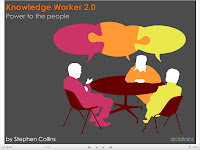
Sometimes you run into something on the web that is soooo helpful. I was reading Luis Suarez's blog and he posted about Stephen Collin 's presentation on "Knowledge Worker 2.0" . Luis says that is simply summarizes everything we know about knowledge management and work - in one single presentation. So, I went through the presentation and, WOW!, I absolutely agree. What a wonderful presentation (w.r.t. content and design)! But Stephen has more to share . Looking for interesting presentations to explain your IT department how you want to work? Look here ! Or, need to explain to someone what social media is and what it could mean for your company? Look here ! Thanks a lot for sharing, Stephen - and Luis.

Future of KM

Image
As I wrote in the previous post , this post would be about "the future of KM as I see it". The previous post mentioned the first question about KM that I was asked. The second question was: in one slide, give your vision of the future of KM. This was my answer: Give options, let people choose for themselves what suites them best (the knowledge manager has the overview, the architectural view). Approach KM problems in a personal and proactive way. Company boundaries will fade (by wiki’s, blogs). People will remain the primary focus of KM (in contrast to technology). Integration of tools (wiki's, blogs, document management, etc.) with the primary work place (for knowledge workers usually email). Document management and records management systems will move to the background, no end-user focus. Always online and therefore(?) always information overload. Role of knowledge brokers will become more important. What is your vision on the future of KM?

KM lessons learned

Image
Some time ago I was asked to sum up, in one sheet, what my lessons learned w.r.t. knowledge management are. I came up with this list: Look for the mechanisms behind the way people work (at first site it's often chaotic) and connect to those mechanisms. Provide solutions for knowledge management problems that closely relate to current working methods. Continuous trial & error, probe, never stop trying new approaches to KM problems. Don't enforce solutions to KM problems. Document management is the basis of KM, start there. Knowledge mapping can work without enforcing participation of employee (with 'enforcing I mean, e.g., having an employee fill in their profile and keep it up to date). Defining a business case for KM is hard if not impossible. Knowledge brokers are a success (implicit or explicit role). KM is about people and people connecting to other people. "Oh, you're looking for info about so-and-so, go talk to him!" I'd love to hear what you th...

ExpertFinder @ I-Know '07

Our paper for the I-Know '07 was accepted! Here's the abstract: Title: ExpertFinder: Collaborative Expertise Localization Abstract: Straightforward expertise localization is crucial for personal and organizational efficiency and productivity. Common issues with existing approaches are the amount of effort required to build up the database and keeping it up-to-date, and the difficulty of establishing a complete coverage of the organization. The ExpertFinder system employs the concepts of referral chaining, social networks and user-generated data to enable a fast, low-effort and thereby low-cost approach to building an expertise localization database. At the same time, ExpertFinder provides a number of views on this database. We describe the design of the system and discuss in detail two pilots conducted at Océ-Technologies and the Telematica Instituut, the findings of which show high user participation and a good coverage of individual employee expertise and overall organizati...

Entry "Knowledge mapping" in Wikipedia

Image
Just a week ago I contributed to Wikipedia for the first time in my life. Quite exciting! I wrote an entry for "knowledge mapping" , based on a definition used in several papers I contributed to. I also added 'knowledge mapping' to the "knowledge management" entry. I was (and am) very curious what would happen with the entry. So, I put a "watcher" on the entry, but that didn't seem to work (no alert that the entry was changed or moved...). Today I checked my entry and to my surprise I was redirected to the entry "knowledge management". My entry was removed and incorporated in this entry for several reasons (refer to "discussion" page of the entries). That wonderful! Within a couple of days this topic, that was missing in the knowledge management entry and in Wikipedia all together, now exists! Samuel

Storytelling - A masterclass with Steve Denning

Image
The power of stories. I think we all can relate to that. Dad and mom told us stories when we were kids (and usually they still do). We read stories all the time and tell others about them. Companies also move, change and progress on stories. Stories of the past. Stories to get something across. Real stories, fiction. Etc. The Ark-group and InsideKnowledge are presenting: 'The secret language of leadership. How leaders inspire action through narrative' with Steve Denning. Denning is the leading author in the area of storytelling. ( Dave Snowden is also an evangelist of storytelling.) I find storytelling very interesting. It really stresses the human side of knowledge management, information management and communication. But I still have a hard time translating all this to the enterprise. Several articles have been written on how you can use storytelling in companies. Nasa and Shell a.o. seem to use this technique to capture and transfer knowledge/information....

New book by Nonaka and Ichijo!: Knowledge Creation and Management

Image
This didn't come up in my feeds, but I accidentally ran into it: There's a new book out by Ichijo & Nonaka (- you know, from "The Knowledge Creating Company", written with Takeuchi ). It's titled: "Knowledge Creation and Management: New Challenges for Managers" (2007). Looks very interesting! It's not only written by them, but lots of great Knowledge Management thinkers have been asked to write one or more chapters. I ordered it and hope to read it soon and let you know what I think of it. Samuel